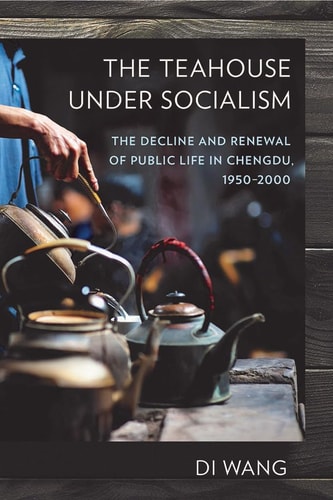
The Teahouse Under Socialism: The Decline and Renewal of Public Life in Chengdu, 1950-2000
0
0
As an Amazon Associate and affiliate partner, Menrva Books earns from qualifying purchases. Learn more
Author Description
To understand a city fully, writes Di Wang, we must observe its most basic units of social life. In The Teahouse under Socialism, Wang does just that, arguing that the teahouses of Chengdu, the capital of Sichuan Province, are some of the most important public spaces?perfect sites for examining the social and economic activities of everyday Chinese. Wang looks at the transformation of these teahouses from private businesses to collective ownership and how state policy and the proprietors' response to it changed the overall economic and social structure of the city. He uses this transformation to illuminate broader trends in China's urban public life from 1950 through the end of the Cultural Revolution and into the post-Mao reform era. In doing so, The Teahouse under Socialism charts the fluctuations in fortune of this ancient cultural institution and analyzes how it survived, and even thrived, under bleak conditions. Throughout, Wang asks such questions as: Why and how did state power intervene in the operation of small businesses? How was "socialist entertainment" established in a local society? How did the well-known waves of political contestation and struggle in China change Chengdu's teahouses and public life? In the end, Wang argues, the answers to such questions enhance our understanding of public life and political culture in the Communist state.
Menrva's Summary
THE THESIS
This book investigates the transformation of Chengdu's teahouses as a lens through which to understand the evolution of public life in China from 1950 to 2000. Di Wang, drawing on his expertise in Chinese history and urban studies, examines how state policies and local responses shaped these vital social spaces, from their collectivization under socialism to their adaptation during the reform era. The analysis focuses on the interplay between government intervention, proprietor agency, and the enduring cultural significance of teahouses in navigating political and economic shifts. Ultimately, the book argues that understanding these seemingly small units of social life provides crucial insights into the broader dynamics of China's urban public sphere and political culture.
THE SCOPE MAP
- Analysis of teahouse transformation from private enterprise to collective ownership.
- Examination of state policy interventions in small businesses and local society.
- Exploration of how "socialist entertainment" was established and evolved.
- Case studies of teahouse adaptation during periods of political contestation and reform.
- Insights into the survival and resilience of an ancient cultural institution under varying political conditions.
- A detailed look at urban public life in Chengdu, Sichuan Province, between 1950 and 2000.
THE AUTHORITY PERSPECTIVE
The book is regarded as a significant contribution to the understanding of Chinese urban history and social life, utilizing the microcosm of Chengdu's teahouses to illuminate broader national trends. Scholars likely appreciate its detailed historical analysis and its focus on the agency of local actors within a state-controlled environment. The work is expected to appeal to those interested in social history, urban studies, and the cultural impact of political change in modern China.
Page Count:
311
Publication Date:
2018-01-01
Publisher:
Cornell University Press
ISBN-10:
1501715496
ISBN-13:
9781501715495
History
Non-Fiction
Social History
Cultural History
Chinese History
Urban Studies
Community Tags
Similar Books