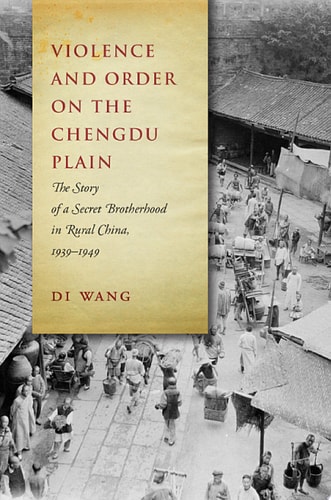
Violence and Order on the Chengdu Plain
0
0
As an Amazon Associate and affiliate partner, Menrva Books earns from qualifying purchases. Learn more
Author Description
In 1939, residents of a rural village near Chengdu watched as Lei Mingyuan, a member of a violent secret society known as the Gowned Brothers, executed his teenage daughter. Six years later, Shen Baoyuan, a sociology student at Yenching University, arrived in the town to conduct fieldwork on the society that once held sway over local matters. She got to know Lei Mingyuan and his family, recording many rare insights about the murder and the Gowned Brothers' inner workings. Using the filicide as a starting point to examine the history, culture, and organization of the Gowned Brothers, Di Wang offers nuanced insights into the structures of local power in 1940s rural Sichuan. Moreover, he examines the influence of Western sociology and anthropology on the way intellectuals in the Republic of China perceived rural communities. By studying the complex relationship between the Gowned Brothers and the Chinese Communist Party, he offers a unique perspective on China's transition to socialism. In so doing, Wang persuasively connects a family in a rural community, with little overt influence on national destiny, to the movements and ideologies that helped shape contemporary China.
Menrva's Summary
THE THESIS
This book investigates the complex interplay of local power structures, secret societies, and intellectual influences in 1940s rural Sichuan. Di Wang uses the shocking filicide of a teenage girl by her father, a member of the Gowned Brothers secret society, as a focal point to explore the society's history, culture, and organization. The study examines how Western sociological and anthropological theories shaped the perceptions of Chinese intellectuals regarding rural communities during the Republic of China era. Furthermore, it analyzes the intricate relationship between the Gowned Brothers and the Chinese Communist Party, offering a distinct viewpoint on China's transition to socialism.
THE SCOPE MAP
- Detailed examination of the Gowned Brothers secret society in rural Sichuan.
- Analysis of a specific instance of filicide as a lens into local power dynamics.
- Exploration of the influence of Western sociology and anthropology on Chinese intellectuals.
- Investigation of the relationship between a local secret society and the Chinese Communist Party.
- Discussion of China's transition to socialism from a rural community perspective.
- Connection of micro-level family events to macro-level national historical movements.
THE AUTHORITY PERSPECTIVE
The book offers nuanced insights into the structures of local power in 1940s rural Sichuan, connecting a specific family's story to broader national movements. It examines the influence of Western social sciences on Chinese intellectuals' understanding of rural life. The work provides a unique perspective on China's transition to socialism through its study of the Gowned Brothers' relationship with the Chinese Communist Party. This scholarly approach is likely to appeal to specialists in Chinese history, sociology, and rural studies.
Page Count:
280
Publication Date:
2018-03-27
Publisher:
Stanford University Press
ISBN-10:
1503605337
ISBN-13:
9781503605336
History
Non-Fiction
Rural Studies
Sociology
Chinese History
Community Tags
Similar Books