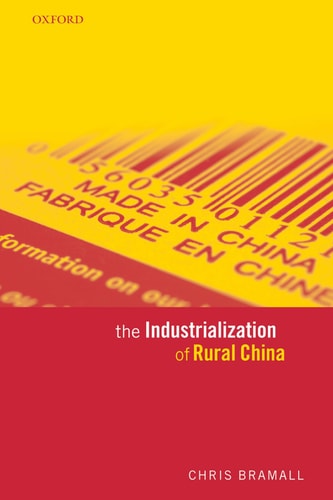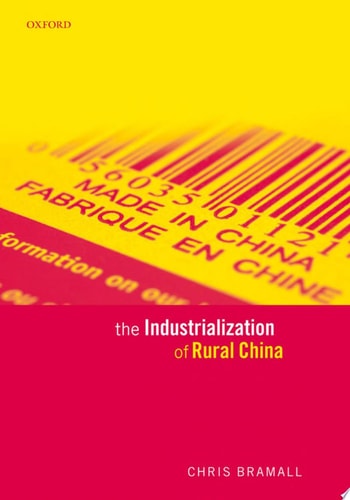
The Industrialization of Rural China
0
0
As an Amazon Associate and affiliate partner, Menrva Books earns from qualifying purchases. Learn more
Author Description
The growth of rural industry in China since 1978 has been explosive. Much of the existing literature explains its growth in terms of changes in economic policy. By means of a combination of privatization, liberalization and fiscal decentralization, it is argued, rural industrialization has taken off. This book takes issue with such claims. Using a newly constructed dataset covering all of China's 2000 plus counties and complemented by a detailed econometric study of county-level industrialization in the provinces of Sichuan, Guangdong and Jiangsu, the author demonstrates that history mattered. More precisely, it is argued that the development of rural industry in the Maoist period set in motion a process of learning-by-doing whereby China's rural workforce gradually acquired an array of skills and competencies. As a result, rural industrialization was accelerating well before the 1978 climacteric. The growth of the 1980s and 1990s is therefore likely to be a continuation of this process. Without prior Maoist development of skills, the growth of the post-1978 era would have been much slower, and perhaps would not have occurred at all - as has been the case in countries such as India and Vietnam. This is not to say that the Maoist legacy was without flaw. Many of the rural industries created under Mao were geared towards meeting defence-related objectives resulting in inefficiencies, and there can be no question that post-1978 policy changes facilitated the growth process. But without the Maoist inheritance, rural industrialization across China would have been unsuccessful.
Menrva's Summary
THE THESIS
Does the explosive growth of rural industry in China since 1978 represent a clean break from the past, or is it a continuation of economic foundations laid during the Maoist era? Chris Bramall, an economist specializing in Chinese development, challenges the conventional narrative that post-1978 liberalization was the sole driver of rural industrialization. By analyzing historical data and economic patterns, he argues that the Maoist period facilitated a critical process of 'learning-by-doing' that equipped the rural workforce with essential skills. This historical inheritance provided the necessary human capital that allowed subsequent policy reforms to succeed where they might otherwise have failed.
THE SCOPE MAP
What You Will Find
- A comprehensive dataset covering over 2,000 Chinese counties.
- Econometric analysis of industrial development in Sichuan, Guangdong, and Jiangsu provinces.
- A comparative framework contrasting China's trajectory with that of India and Vietnam.
Scope Limits
- The study focuses primarily on the transition from the Maoist period to the late 1990s.
- It does not provide an exhaustive analysis of contemporary 21st-century digital or service-sector industrialization.
THE AUTHORITY PERSPECTIVE
Scholars and economists frequently cite this work for its rigorous use of county-level data to challenge dominant economic orthodoxy regarding Chinese development. Readers often note the academic density of the prose, which is intended for researchers and students of development economics.
Page Count:
436
Publication Date:
2007-01-01
Publisher:
Oxford University Press
ISBN-10:
0191534714
ISBN-13:
9780191534713
Economics
China
Economics history
Chinese History
Rural Studies