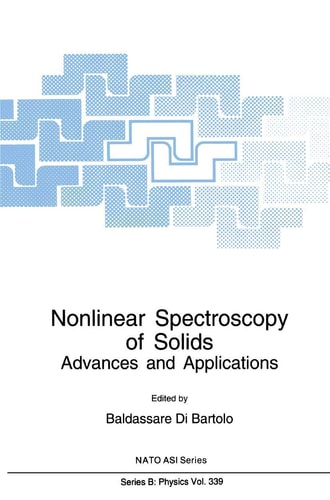
Nonlinear Spectroscopy of Solids: Advances and Applications
0
0
As an Amazon Associate and affiliate partner, Menrva Books earns from qualifying purchases. Learn more
Author Description
This report presents an account of the course "Nonlinear Spectroscopy of Solids: Advances and Applications" held in Erice, Italy, from June 16 to 30, 1993. This meeting was organized by the International School of Atomic and Molecular Spectroscopy of the "Ettore Majorana" Centre for Scientific Culture. The purpose of this course was to present and discuss physical models, mathematical formalisms, experimental techniques, and applications relevant to the subject of nonlinear spectroscopy of solid state materials. The universal availability and application of lasers in spectroscopy has led to the widespread observation of nonlinear effects in the spectroscopy of materials. Nonlinear spectroscopy encompasses many physical phenomena which have their origin in the monochromaticity, spectral brightness, coherence, power density and tunability of laser sources. Conventional spectroscopy assumes a linear dependence between the applied electromagnetic field and the induced polarization of atoms and molecules. The validity of this assumption rests on the fact that even the most powerful conventional sources of light produce a light intensity which is not strong enough to equalize the rate of stimulated emission and that of the experimentally observed decay. A different situation may arise when laser light sources are used, particularly pulsed lasers. The use of such light sources can make the probability of induced emission comparable to, or even greater than, the probability of the observed decay; in such cases the nonlinearity of the response of the system is revealed by the experimental data and new properties, not detectable by conventional spectroscopy, will emerge.
Menrva's Summary
THE THESIS
This report details the proceedings of a specialized course on nonlinear spectroscopy of solids, focusing on recent advancements and practical applications. The course, held in Erice, Italy, in June 1993, aimed to explore physical models, mathematical frameworks, experimental methods, and the application of nonlinear spectroscopy to solid-state materials. It highlights how the unique properties of lasers, such as monochromaticity, spectral brightness, coherence, and tunability, enable the observation of nonlinear effects that are not apparent with conventional light sources. The fundamental difference lies in the interaction of intense laser light with matter, where the induced polarization response is no longer linear, revealing new material properties beyond the scope of traditional spectroscopy.
THE SCOPE MAP
- Detailed accounts of physical models and mathematical formalisms in nonlinear spectroscopy.
- Discussions on advanced experimental techniques for probing solid-state materials.
- Case studies and examples of applications of nonlinear spectroscopy.
- Explanation of how laser properties (monochromaticity, brightness, coherence, power, tunability) enable nonlinear effects.
- Comparison between linear and nonlinear responses of matter to electromagnetic fields.
- Insights into phenomena observable only with high-intensity laser sources, particularly pulsed lasers.
THE AUTHORITY PERSPECTIVE
This collection of reports from a 1993 NATO Advanced Study Institute offers a snapshot of the field of nonlinear spectroscopy of solids. The material presented likely appeals to researchers and advanced students in physics and materials science seeking to understand the theoretical underpinnings and experimental methodologies of this specialized area. The focus on laser-induced phenomena suggests a technical and in-depth treatment of the subject matter. The compilation serves as a valuable reference for those investigating the advanced applications and emerging techniques in the study of solid-state materials.
Page Count:
664
Publication Date:
1995-04-30
Publisher:
Springer
ISBN-10:
0306449161
ISBN-13:
9780306449161
Science
Physics
Spectroscopy
Community Tags
Similar Books