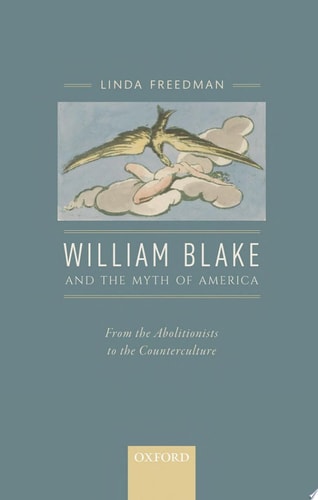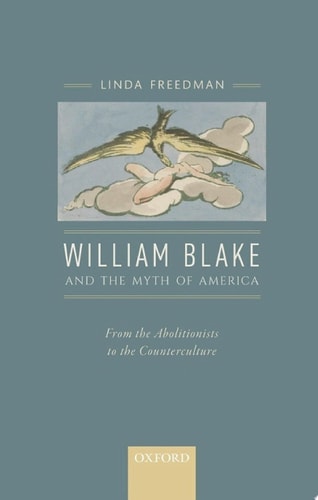
William Blake and the Myth of America: From the Abolitionists to the Counterculture
0
0
As an Amazon Associate and affiliate partner, Menrva Books earns from qualifying purchases. Learn more
Author Description
This volume tells the story of William Blake's literary reception in America and suggests that ideas about Blake's poetry and personality helped shape mythopoeic visions of America from the Abolitionists to the counterculture. It links high and low culture and covers poetry, music, theology, and the novel. American writers have turned to Blake to rediscover the symbolic meaning of their country in times of cataclysmic change, terror, and hope. Blake entered American society when slavery was rife and civil war threatened the fragile experiment of democracy. He found his moment in the mid twentieth-century counterculture as left-wing Americans took refuge in the arts at a time of increasingly reactionary conservatism, vicious racism, pervasive sexism, dangerous nuclear competition, and an increasingly unpopular war in Vietnam, the fires of Orc raging against the systems of Urizen. Blake's America, as a symbol of cyclical hope and despair, influenced many Americans who saw themselves as continuing the task of prophecy and vision. Blakean forms of bardic song, aphorism, prophecy, and lament became particularly relevant to a literary tradition which centralised the relationship between aspiration and experience. His interrogations of power and privilege, freedom and form resonated with Americans who repeatedly wrestled with the deep ironies of new world symbolism and sought to renew a Whitmanesque ideal of democracy through affection and openness towards alterity.
Menrva's Summary
THE THESIS
This volume investigates how the reception of William Blake’s poetry and persona served as a foundational influence on American mythopoeic identity from the era of the Abolitionists through the mid-twentieth-century counterculture. Linda Freedman, an academic specializing in American literature, utilizes a broad interdisciplinary approach to trace how Blake’s work was adapted by American writers and thinkers to navigate periods of national crisis. The book argues that Blake’s prophetic voice provided a symbolic framework for Americans to critique power structures, address social injustices, and redefine democratic ideals during times of political and cultural upheaval.
THE SCOPE MAP
What You Will Find
- Analysis of Blakean influence on American poetry, music, theology, and the novel.
- Examination of the historical intersection between Blake’s reception and American social movements, including Abolitionism and the Vietnam-era counterculture.
- Exploration of how Blake’s concepts of prophecy, bardic song, and lament were integrated into the American literary tradition.
Scope Limits
- The text does not provide a comprehensive biography of William Blake, focusing instead on his reception history in the United States.
- The analysis does not cover contemporary digital-age interpretations of Blake’s work.
THE AUTHORITY PERSPECTIVE
Scholars and critics recognize this work as a significant contribution to the study of transatlantic literary influence and the history of American intellectual thought. Readers frequently note the academic density of the prose, which effectively bridges the gap between high-culture literary analysis and broader social history.
Page Count:
288
Publication Date:
2018-01-01
Publisher:
OUP Oxford
ISBN-10:
019254277X
ISBN-13:
9780192542779
Poetry
Historical
United States
In literature
Regional
History of Ideas
Literary Criticism
American History
Community Tags
Similar Books