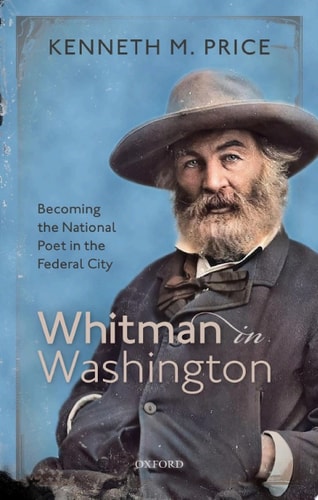
Whitman in Washington: Becoming the National Poet in the Federal City
0
0
As an Amazon Associate and affiliate partner, Menrva Books earns from qualifying purchases. Learn more
Author Description
During Walt Whitman's decade in Washington, DC, 1863-1873, he labored intensely, at times seeming to have three lives at once. He wrote the most distinguished journalism of his career; came into his own as a writer of letters; crafted memorable Civil War poetry, Drum-Taps and Sequel to Drum-Taps and later folded it into heavily revised and expanded versions of Leaves of Grass; and produced his searching but also flawed critique of American culture, Democratic Vistas. Whitman's work through the first three editions of Leaves often receives the highest praise, yet his writing in the Washington years is exceptional, too, by any reckoning—and is all the more remarkable given that he also cared for thousands of wounded and sick soldiers in Washington hospitals, serving as an attentive visitor. In addition, he served as a government clerk in various positions, most notably in the attorney general's office when much was accomplished on the road toward a multi-racial democracy including efforts to suppress the Ku Klux Klan, and much was also missed (both by the attorney general's office and by Whitman) in the efforts to advance a more just and vibrant union. This book analyses Whitman's integrated life, writings, and government work in his urban context to re-evaluate the writer and the nation's capital in a time of transformation. Drawing on an expanded Whitman corpus, including nearly 3,000 Whitman documents the author recently identified in the National Archives, Whitman in Washington demonstrates that the power of Whitman's Civil War and Reconstruction writing emerges, more fully than we could ever before have imagined, from his intimate knowledge of the capital city, its bureaucracies, and its tumultuous post-war history.
Menrva's Summary
THE THESIS
How did Walt Whitman’s decade of residence in Washington, D.C. during the Civil War and Reconstruction shape his identity as the national poet and influence his literary output? Kenneth M. Price, a scholar of American literature, utilizes an extensive collection of newly identified archival documents to argue that Whitman’s professional life as a government clerk and his volunteer work in military hospitals were not peripheral to his writing, but central to the development of his mature voice. By analyzing the intersection of Whitman’s bureaucratic duties, his personal correspondence, and his literary revisions, Price demonstrates that the poet’s work during this period was inextricably linked to the political and social transformation of the capital city.
THE SCOPE MAP
What You Will Find
- Analysis of Whitman’s contributions to journalism, poetry, and cultural critique during the 1863-1873 period.
- Examination of Whitman’s role as a government clerk in the attorney general’s office.
- Integration of nearly 3,000 newly discovered documents from the National Archives.
Scope Limits
- The study is geographically and chronologically confined to Whitman’s decade in Washington, D.C.
- The text does not provide a comprehensive biography of Whitman’s entire life, focusing instead on this specific transformative window.
THE AUTHORITY PERSPECTIVE
Scholars recognize this work as a significant contribution to Whitman studies due to its rigorous use of previously untapped archival evidence. The text is noted for its ability to bridge the gap between literary analysis and historical context, providing a detailed look at the poet’s professional and personal life in the federal city.
Page Count:
215
Publication Date:
2020-01-01
Publisher:
OUP Oxford
ISBN-10:
0192577670
ISBN-13:
9780192577672
Biography
History
Poetry
Indigenous
Civil War
Poets American
Poetry
American History
Literary Criticism
19th Century
Reconstruction Era
Community Tags
Similar Books