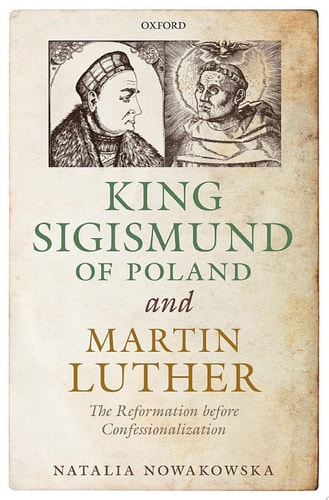
King Sigismund of Poland and Martin Luther: The Reformation before Confessionalization
0
0
As an Amazon Associate and affiliate partner, Menrva Books earns from qualifying purchases. Learn more
Author Description
The first major study of the early Reformation and the Polish monarchy for over a century, this volume asks why Crown and church in the reign of King Sigismund I (1506-1548) did not persecute Lutherans. It offers a new narrative of Luther's dramatic impact on this monarchy -- which saw violent urban Reformations and the creation of Christendom's first Lutheran principality by 1525 -- placing these events in their comparative European context. King Sigismund's realm appears to offer a major example of sixteenth-century religious toleration: the king tacitly allowed his Hanseatic ports to enact local Reformations, enjoyed excellent relations with his Lutheran vassal duke in Prussia, allied with pro-Luther princes across Europe, and declined to enforce his own heresy edicts. Polish church courts allowed dozens of suspected Lutherans to walk free. Examining these episodes in turn, this study does not treat toleration purely as the product of political calculation or pragmatism. Instead, through close analysis of language, it reconstructs the underlying cultural beliefs about religion and church (ecclesiology) held by the king, bishops, courtiers, literati, and clergy -- asking what, at heart, did these elites understood 'Lutheranism' and 'catholicism' to be? It argues that the ruling elites of the Polish monarchy did not persecute Lutheranism because they did not perceive it as a dangerous Other -- but as a variant form of catholic Christianity within an already variegated late medieval church, where social unity was much more important than doctrinal differences between Christians. Building on John Bossy and borrowing from J.G.A. Pocock, it proposes a broader hypothesis on the Reformation as a shift in the languages and concept of orthodoxy.
Menrva's Summary
THE THESIS
This study investigates why the Polish Crown and church under King Sigismund I refrained from persecuting Lutheranism during the early Reformation. Natalia Nowakowska, a historian specializing in the Jagiellonian era, utilizes primary source analysis of language and ecclesiology to challenge traditional narratives of religious conflict. She argues that Polish elites viewed Lutheranism not as a dangerous heresy, but as a variant form of catholic Christianity, prioritizing social cohesion over strict doctrinal uniformity.
THE SCOPE MAP
What You Will Find
- Analysis of the reign of King Sigismund I from 1506 to 1548.
- Examination of the creation of the first Lutheran principality in Prussia.
- Comparative European context regarding religious toleration and heresy edicts.
- Linguistic analysis of contemporary beliefs about 'Lutheranism' and 'catholicism'.
Scope Limits
- The study focuses specifically on the Polish monarchy and its immediate political sphere.
- It does not provide a comprehensive history of the Reformation across all of Europe.
THE AUTHORITY PERSPECTIVE
Scholars recognize this work as a significant contribution to Reformation studies, particularly for its nuanced approach to the concept of religious toleration. Readers frequently note the academic density of the prose and the author's sophisticated application of linguistic and political theory.
Page Count:
293
Publication Date:
2017-01-01
Publisher:
OUP Oxford
ISBN-10:
0192542923
ISBN-13:
9780192542922
History
Polish History
Religious History
Europe
Reformation
Church & State
Poland
Political History
European History
Community Tags
Similar Books