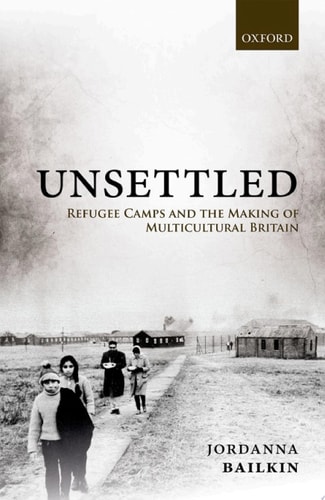
Unsettled: Refugee Camps and the Making of Multicultural Britain
0
0
As an Amazon Associate and affiliate partner, Menrva Books earns from qualifying purchases. Learn more
Author Description
Today, no one really thinks of Britain as a land of camps. Camps seem to happen 'elsewhere', from Greece, to Palestine, to the global South. Yet over the course of the twentieth century, dozens of British refugee camps housed hundreds of thousands of Belgians, Jews, Basques, Poles, Hungarians, Anglo-Egyptians, Ugandan Asians, and Vietnamese. Refugee camps in Britain were never only for refugees. Refugees shared a space with Britons who had been displaced by war and poverty, as well as thousands of civil servants and a fractious mix of volunteers. Unsettled: Refugee Camps and the Making of Multicultural Britain explores how these camps have shaped today's multicultural Britain. They generated unique intimacies and frictions, illuminating the closeness of individuals that have traditionally been kept separate -- 'citizens' and 'migrants', but also refugee populations from diverse countries and conflicts. As the world's refugee crisis once again brings to Europe the challenges of mass encampment, Unsettled offers warnings from a liberal democracy's recent past. Through lively anecdotes from interviews with former camp residents and workers, Unsettled conveys the vivid, everyday history of refugee camps, which witnessed births and deaths, love affairs and violent conflicts, strikes and protests, comedy and tragedy. Their story -- like that of today's refugee crisis -- is one of complicated intentions that played out in unpredictable ways. The aim of this book is not to redeem camps -- nor, indeed, to condemn them. It is to refuse to ignore them. Unsettled speaks to all who are interested in the plight of the encamped, and the global uses of encampment in our present world.
Menrva's Summary
THE THESIS
How did the presence of refugee camps throughout the twentieth century fundamentally shape the social and cultural landscape of modern Britain? Jordanna Bailkin, a professor of history, utilizes archival research and oral history interviews to argue that these sites of encampment were not peripheral anomalies but central spaces where the boundaries between citizens and migrants were negotiated and redefined. The book posits that these camps served as laboratories for multiculturalism, revealing the complex interactions between displaced populations, local Britons, and state authorities.
THE SCOPE MAP
What You Will Find
- Historical analysis of British refugee camps housing Belgians, Jews, Basques, Poles, Hungarians, Anglo-Egyptians, Ugandan Asians, and Vietnamese.
- Examination of the social dynamics between refugees, displaced local Britons, civil servants, and volunteers.
- Qualitative evidence derived from interviews with former camp residents and staff.
Scope Limits
- The text focuses specifically on the British experience and does not provide a comprehensive global history of refugee encampment.
- The analysis prioritizes social and cultural history over a purely economic or policy-driven assessment of refugee management.
THE AUTHORITY PERSPECTIVE
Scholars and historians frequently cite this work for its ability to integrate intimate personal narratives with broader structural analysis of British state policy. Experts highlight the book as a significant contribution to the study of migration, noting its success in challenging the perception of Britain as a nation untouched by the history of mass encampment.
Page Count:
304
Publication Date:
2018-01-01
Publisher:
OUP Oxford
ISBN-10:
0192545264
ISBN-13:
9780192545268
History
European History
Great Britain
Modern History
Refugees
British History
Migration Studies
Sociology
Community Tags
Similar Books