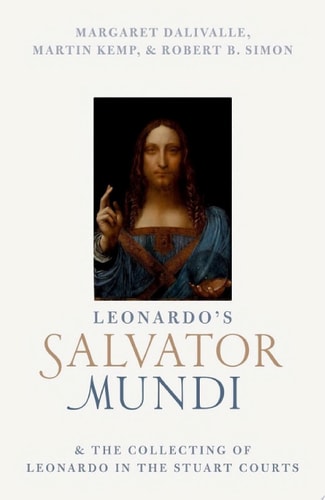
Leonardo's Salvator Mundi and the Collecting of Leonardo in the Stuart Courts
0
0
As an Amazon Associate and affiliate partner, Menrva Books earns from qualifying purchases. Learn more
Author Description
The Salvator Mundi is the first Leonardo painting to be discovered for over a century. Following its re-emergence, it played a leading role in the landmark Leonardo exhibition at the National Gallery in London in 2011, after which it was purchased by a Russian oligarch. In 2017 it was auctioned by Christie's in New York, fetching the world record price of $450m, and now forms part of the collection of Louvre Abu Dhabi. The Salvator Mundi may be seen as the devotional counterpart to the Mona Lisa, having an extraordinary, communicative presence. The artist has reformed the very traditional subject matter in a number of ways. The elusiveness of Christ's expression suggests his spiritual origins beyond the world of the senses. The traditional sphere of the earth has been transformed into a rock-crystal orb and signifies a crystalline sphere of the heavens. In addition to its spiritual dimension, the image exploits Leonardo's optical knowledge and his growing sense of the illusiveness of seeing. Only the blessing hand is in reasonably sharp focus, with his features softly veiled. The scintillating curls of his hair are characterised in line with his theory that the physics of the curling of hair is analogous to vortex motion in water. This book looks at evidence of Leonardo's Salvator Mundi in the collections of Charles I and Charles II. It explores the appraisal of works by Leonardo at the Stuart courts, and proposes that how works attributed to Leonardo were first encountered and understood in seventeenth-century Britain would shape the wider evolution of Leonardo as a cultural icon. This volume gives a dramatic first-hand account of the modern-day discovery of the painting, from its purchase in a minor New Orleans auction house, to the cleaning of the picture that would disclose it as Leonardo's startling original, and the research processes that would uncover illustrious and obscure former owners. The book presents the definitive study of the new masterpiece.
Menrva's Summary
THE THESIS
This volume investigates the provenance and historical significance of Leonardo da Vinci's 'Salvator Mundi' within the context of seventeenth-century British royal collections. The authors, including renowned Leonardo scholar Martin Kemp, utilize archival research and technical analysis to trace the painting's journey from its origins to its modern-day rediscovery. They argue that the reception of Leonardo's work in the Stuart courts fundamentally influenced his subsequent status as a global cultural icon.
THE SCOPE MAP
What You Will Find
- Historical analysis of the Stuart court collections under Charles I and Charles II.
- A detailed account of the painting's modern discovery in a New Orleans auction house.
- Technical insights into Leonardo's optical theories and painting techniques.
- Documentation of the restoration process that revealed the work's attribution.
Scope Limits
- The text does not provide a comprehensive biography of Leonardo da Vinci.
- It does not focus on the broader political history of the Stuart dynasty beyond their art collecting habits.
THE AUTHORITY PERSPECTIVE
Experts recognize this work as a primary resource for understanding the provenance and technical authentication of the 'Salvator Mundi'. Readers frequently note the scholarly rigor and the detailed, step-by-step documentation of the painting's modern-day recovery.
Page Count:
401
Publication Date:
2019-01-01
Publisher:
OUP Oxford
ISBN-10:
0192543296
ISBN-13:
9780192543295
History
Non-Fiction
Biography
Art Italian
Modern History
Art History
Art Patronage
Community Tags
Other Editions(2)
Similar Books













Reader Comments
Share Your Thoughts
No comments yet. Be the first to share your thoughts!