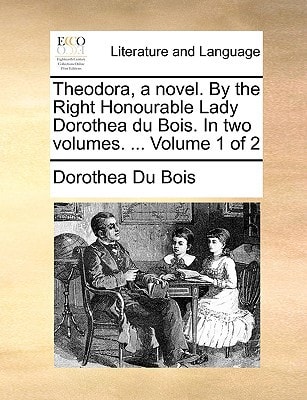
Theodora, a Novel
0
0
As an Amazon Associate and affiliate partner, Menrva Books earns from qualifying purchases. Learn more
Author Description
The 18th century was a wealth of knowledge, exploration and rapidly growing technology and expanding record-keeping made possible by advances in the printing press. In its determination to preserve the century of revolution, Gale initiated a revolution of its own: digitization of epic proportions to preserve these invaluable works in the largest archive of its kind. Now for the first time these high-quality digital copies of original 18th century manuscripts are available in print, making them highly accessible to libraries, undergraduate students, and independent scholars. Western literary study flows out of eighteenth-century works by Alexander Pope, Daniel Defoe, Henry Fielding, Frances Burney, Denis Diderot, Johann Gottfried Herder, Johann Wolfgang von Goethe, and others. Experience the birth of the modern novel, or compare the development of language using dictionaries and grammar discourses. ++++ The below data was compiled from various identification fields in the bibliographic record of this title. This data is provided as an additional tool in helping to insure edition identification: ++++ British Library T106576 London: printed for the author, by C. Kiernan, 1770. 2v.; 12°
Menrva's Summary
THE PULSE
A young woman's life is irrevocably altered by a secret correspondence. Lady Theodora, a woman of spirit and intelligence, finds her world confined by the societal expectations of 18th-century England. Her objective is to navigate these constraints and perhaps find a path to personal fulfillment, but her clandestine exchange of letters with a mysterious correspondent introduces unforeseen complications and dangers. The rigid social structures and the potential for scandal serve as the primary forces opposing her. The narrative framework appears to be primarily epistolary, relying on the exchange of letters to drive the plot and reveal character.
INSIDE THE PAGES
- The novel is presented primarily through letters exchanged between characters.
- It offers a glimpse into the social customs and expectations of the 18th century.
- Theodora's personal growth and her pursuit of agency are central themes.
- The narrative explores the consequences of secret communication and hidden desires.
- The setting is predominantly England during the late 18th century.
- The plot involves elements of romance and potential social intrigue.
- The author, Lady Dorothea du Bois, was a contemporary figure whose own life may inform the narrative.
THE COLLECTIVE ECHO
Theodora, published in 1770, is a notable example of an 18th-century epistolary novel, a genre popular for its ability to convey intimacy and psychological depth. As a work by Lady Dorothea du Bois, it offers insight into the literary contributions of women during this period, often overlooked in broader historical surveys. The novel likely engages with themes of social constraint, personal aspiration, and the complexities of romantic relationships as understood within its historical context. Its structure, relying on correspondence, would have allowed readers direct access to characters' thoughts and feelings, fostering a sense of immediacy and emotional connection.
Page Count:
262
Publication Date:
1770-01-01
Publisher:
Gale ECCO, Print Editions
ISBN-10:
1140766538
ISBN-13:
9781140766537
Fiction
Historical Fiction
18th century
Epistolary Novel
Community Tags
Similar Books