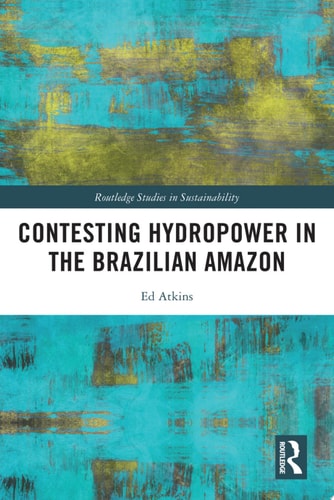
Contesting Hydropower in the Brazilian Amazon
0
0
As an Amazon Associate and affiliate partner, Menrva Books earns from qualifying purchases. Learn more
Author Description
In Contesting Hydropower in the Brazilian Amazon, Ed Atkins focuses on how local, national, and international civil society groups have resisted the Belo Monte and São Luiz do Tapajós hydroelectric projects in Brazil. In doing so, Atkins explores how contemporary opposition to hydropower projects demonstrate a form of ‘contested sustainability’ that highlights the need for sustainable energy transitions to take more into account than merely greenhouse gas emissions. The assertion that society must look to successfully transition away from fossil fuels and towards sustainable energy sources often appears assured in contemporary environmental governance. However, what is less certain is who decides which forms of energy are deemed ‘sustainable.’ Contesting Hydropower in the Brazilian Amazon explores one process in which the sustainability of a ‘green’ energy source is contested. It focuses on how civil society actors have both challenged and reconfigured dominant pro-dam assertions that present the hydropower schemes studied as renewable energy projects that contribute to sustainable development agendas. The volume also examines in detail how anti-dam actors act to render visible the political interests behind a project, whilst at the same time linking the resistance movement to wider questions of contemporary environmental politics. This interdisciplinary work will be of great interest to students and scholars of sustainable development, sustainable energy transitions, environmental justice, environmental governance, and development studies.
Menrva's Summary
THE THESIS
This book investigates the complex and often contentious landscape of hydropower development in the Brazilian Amazon, specifically focusing on the resistance to the Belo Monte and São Luiz do Tapajós projects. It examines how diverse civil society groups, operating at local, national, and international levels, have challenged the prevailing narratives of 'contested sustainability' surrounding these large-scale energy initiatives. The work argues that the transition to sustainable energy sources requires a broader consideration beyond mere greenhouse gas emissions, questioning who defines 'sustainable' energy and highlighting the political interests embedded within such projects. By analyzing the strategies of anti-dam actors, the book reveals how resistance movements reconfigure dominant pro-dam assertions and connect to wider environmental politics.
THE SCOPE MAP
- Analysis of civil society resistance to the Belo Monte and São Luiz do Tapajós hydroelectric projects.
- Exploration of the concept of 'contested sustainability' in energy transitions.
- Examination of how hydropower projects are presented as renewable and contributing to sustainable development.
- Detailed study of how anti-dam actors expose political interests behind energy projects.
- Connection of resistance movements to broader environmental politics and governance.
- Interdisciplinary perspectives from sustainable development, environmental justice, and development studies.
THE AUTHORITY PERSPECTIVE
This interdisciplinary work is positioned to be of significant interest to students and scholars in fields such as sustainable development, environmental justice, and development studies. The book's focus on the contestation of 'sustainable' energy sources and the political dimensions of environmental governance suggests a critical examination of contemporary energy transitions. By analyzing the specific case studies of Brazilian hydropower projects, it offers insights into how civil society actors challenge dominant narratives and advocate for more inclusive definitions of sustainability. The research highlights the need to look beyond emissions data to understand the true impact and decision-making processes behind large-scale energy infrastructure.
Page Count:
236
Publication Date:
2020-11-15
Publisher:
Routledge
ISBN-10:
1000220443
ISBN-13:
9781000220445
Non-Fiction
History
Politics
Energy policy
Sustainability
Community Tags
Similar Books