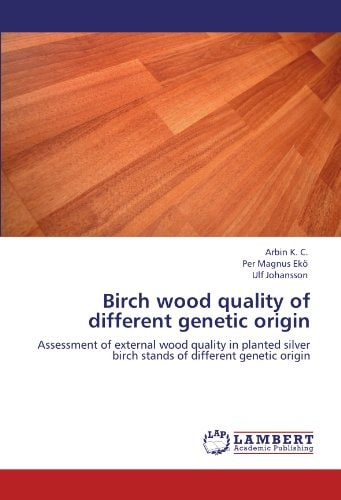
Birch Wood Quality of Different Genetic Origin
0
0
As an Amazon Associate and affiliate partner, Menrva Books earns from qualifying purchases. Learn more
Author Description
The main objective of the research was to find out how the wood quality differed among Silver birch provenances. The study was conducted in family, provenance and tree species experiments in SW Sweden. External features like stem straightness, spike knots, double leader, diameter, tree height, leaning and other defects were measured and analyzed. Significant differences were found between birch families and provenances for a number of measured parameters. In the family experiment, significant differences between families were found for the parameters straight trees and diameter while no significant differences were found for others measured parameters like spike knots, forking, leaning and tree height. The local provenance "T nnersj heden" had the best overall quality and growth in the provenance experiment while Kulb cksliden provenance (North Sweden) had a low overall quality. In the tree species experiment, Asarum was suggested a good quality provenance with an overall high quality performance and a low percentage of leaning trees while Visings was judged a bad quality provenance with a high percentage of crooked stems and a many leaning trees.
Menrva's Summary
THE THESIS
This research investigates the variation in wood quality among different genetic origins of Silver birch (Betula pendula) in southwestern Sweden. The study analyzed external features such as stem straightness, spike knots, double leaders, diameter, tree height, and leaning in family, provenance, and tree species experiments. Significant differences were identified between birch families and provenances for several parameters, indicating a genetic component to wood quality and growth. The findings highlight specific provenances, like 'T nnersj heden' and Asarum, as having superior quality and growth performance compared to others, such as Kulb cksliden and Visings.
THE SCOPE MAP
- Analysis of wood quality differences among Silver birch provenances.
- Conducted within family, provenance, and tree species experiments in SW Sweden.
- Measured external features including stem straightness, spike knots, double leaders, diameter, tree height, and leaning.
- Identified significant differences between birch families and provenances for key parameters.
- Determined the 'T nnersj heden' provenance as having the best overall quality and growth in the provenance experiment.
- Noted Kulb cksliden provenance (North Sweden) exhibited low overall quality.
- Suggested Asarum as a good quality provenance in the tree species experiment with high performance and low leaning.
- Identified Visings as a poor quality provenance with a high percentage of crooked stems and leaning trees.
THE AUTHORITY PERSPECTIVE
The study provides a detailed analysis of wood quality variations in Silver birch based on genetic origin. It systematically documents differences observed across various experimental setups and highlights specific provenances with superior characteristics. The research contributes to understanding the genetic basis of wood quality and growth in birch species, offering practical insights for forestry management and breeding programs in Sweden.
Page Count:
72
Publication Date:
2012-02-22
Publisher:
LAP Lambert Academic Publishing
ISBN-10:
3848406705
ISBN-13:
9783848406708
Non-Fiction
Science
Wood Science
Botany
Sweden
Genetics
Forestry
Community Tags
Similar Books