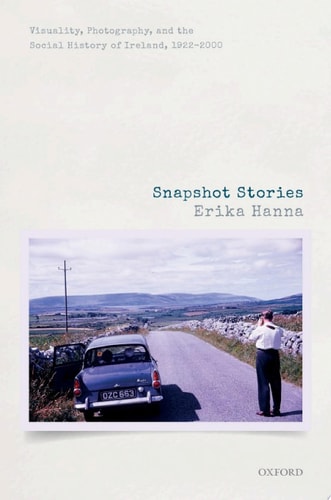
Snapshot Stories: Visuality, Photography, and the Social History of Ireland, 1922-2000
0
0
As an Amazon Associate and affiliate partner, Menrva Books earns from qualifying purchases. Learn more
Author Description
During the twentieth century, men and women across Ireland picked up cameras, photographing days out at the beach, composing views of Ireland's cities and countryside, and recording political events as they witnessed them. Indeed, while foreign photographers often still focused on the image of Ireland as bucolic rural landscape, Irish photographers-snapshotter and professional alike-were creating and curating photographs which revealed more complex and diverse images of Ireland. Snapshot Stories explores these stories. Erika Hanna examines a diverse array of photographic sources, including family photograph albums, studio portraits, the work of photography clubs and community photography initiatives, alongside the output of those who took their cameras into the streets to record violence and poverty. The volume shows how Irish men and women used photography in order to explore their sense of self and society and examines how we can use these images to fill in the details of Ireland's social history. By exploring this rich array of sources, Snapshot Stories asks what it means to see-to look, to gaze, to glance-in modern Ireland, and explores how conflicts regarding vision and visuality have repeatedly been at the centre of Irish life.
Menrva's Summary
THE THESIS
How did the act of photography shape the social history and self-perception of Ireland between 1922 and 2000? Erika Hanna, a historian specializing in visual culture, utilizes a broad spectrum of photographic evidence to argue that the camera served as a primary tool for Irish citizens to construct their own identity, countering external, romanticized depictions of the nation. The work posits that visuality and the act of looking are central to understanding the complexities of modern Irish social development.
THE SCOPE MAP
What You Will Find
- Analysis of family photograph albums and studio portraits from the 20th century.
- Examination of photography club archives and community-led visual initiatives.
- Documentation of street photography capturing political violence and economic conditions.
- Theoretical exploration of the act of gazing and visual perception in a national context.
Scope Limits
- The study focuses primarily on the internal Irish perspective rather than a comprehensive history of foreign photojournalism in Ireland.
- The analysis does not prioritize technical photographic history or the evolution of camera hardware.
THE AUTHORITY PERSPECTIVE
Scholars and historians recognize this work as a significant contribution to the study of Irish visual culture and social history. Readers frequently note the academic rigor of the text, which successfully bridges the gap between cultural theory and historical documentation.
Page Count:
288
Publication Date:
2020-01-01
Publisher:
OUP Oxford
ISBN-10:
0192555863
ISBN-13:
9780192555861
Photography
History
Great Britain
Ireland
PHOTOGRAPHY History
Social History
Modern History
Photographers
Visual Culture
Social change
Community Tags
Similar Books