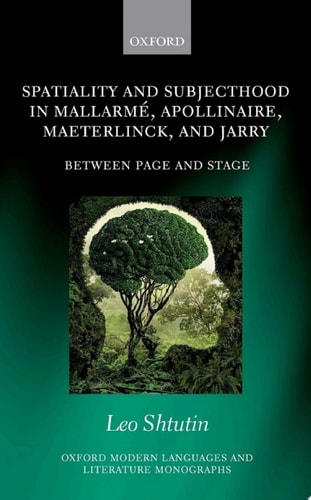
Spatiality and Subjecthood in Mallarmé, Apollinaire, Maeterlinck, and Jarry: Between Page and Stage
0
0
As an Amazon Associate and affiliate partner, Menrva Books earns from qualifying purchases. Learn more
Author Description
This study explores the interrelationship between spatiality and subjecthood in the work of Stéphane Mallarmé, Guillaume Apollinaire, Maurice Maeterlinck, and Alfred Jarry. Concerned with various modes of poetry and drama, it also examines the cross-pollination that can occur between these modes, focusing on a range of core texts including Mallarmé's Igitur and Un Coup de dés; Apollinaire's 'Zone' and various of his calligrammes; Maeterlinck's early one-act plays: L'Intruse, Les Aveugles, and Intérieur; and Jarry's Ubu roi and César-Antechrist.. The poetic and dramatic practices of these four authors are assessed against the broader cultural and philosophical contexts of the fin de siècle. The fin de siècle witnessed a profound epistemological shift: the Newtonian-Cartesian paradigm, increasingly challenged throughout the nineteenth century, was largely dismantled, with ramifications beyond physics, philosophy, and psychology. Chapter 1 introduces three foundational notions—Newtonian absolute space, the unitary Cartesian subject, and subject-object dualism—that were challenged and ultimately overthrown in turn-of-the-century science and art. Developments in theatre architecture and typographic design are examined against this philosophical backdrop with a view to establishing a diachronic and interdisciplinary framework of the authors in question. Chapter 2 focuses on the spatial dimension of Mallarmé's Un Coup de dés and Apollinaire's calligrammes—works which defamiliarise page-space by undermining various (naturalised) conventions of paginal configuration. In Chapter 3, the notion of liminality is implemented in an analysis of character and diegetic space as constructed in Jarry's Ubu roi and Maeterlinck's one-acts. Chapters 4 and Chapter 5 undertake a more abstract investigation of parallel inverse processes-the subjectivisation of space and the spatialisation of the subject—manifest not only in the works of Mallarmé, Maeterlinck, Apollinaire, and Jarry, but in t
Menrva's Summary
THE THESIS
This study investigates how the intersection of spatiality and subjecthood in the works of Mallarmé, Apollinaire, Maeterlinck, and Jarry reflects the epistemological collapse of the Newtonian-Cartesian paradigm at the turn of the twentieth century. Leo Shtutin, an academic researcher, utilizes a comparative framework to analyze how these four authors dismantled traditional notions of absolute space and the unitary subject. By examining both poetic texts and dramatic performances, the author argues that these writers mirrored broader cultural shifts in physics, philosophy, and psychology through their innovative use of page-space and stage-space.
THE SCOPE MAP
What You Will Find
- Analysis of fin de siècle cultural and philosophical contexts.
- Examination of typographic design in Mallarmé's Un Coup de dés and Apollinaire's calligrammes.
- Investigation of liminality in Jarry's Ubu roi and Maeterlinck's early one-act plays.
- Theoretical exploration of the subjectivisation of space and the spatialisation of the subject.
Scope Limits
- The study focuses primarily on the specific works of the four named authors and does not provide a comprehensive survey of all modernist literature.
- The analysis is restricted to the period surrounding the fin de siècle and does not extend into later avant-garde movements.
THE AUTHORITY PERSPECTIVE
Scholars in the field of modern languages recognize this work as a rigorous interdisciplinary study that bridges the gap between literary theory and theatre history. Readers frequently note the academic density of the prose, which is intended for advanced students and researchers of French literature and modernist aesthetics.
Page Count:
238
Publication Date:
2019-01-01
Publisher:
OUP Oxford
ISBN-10:
0192554948
ISBN-13:
9780192554949
History
Philosophy
Indigenous
Literary Criticism
19th Century
French literature
Drama Studies
Modernism
Community Tags
Similar Books