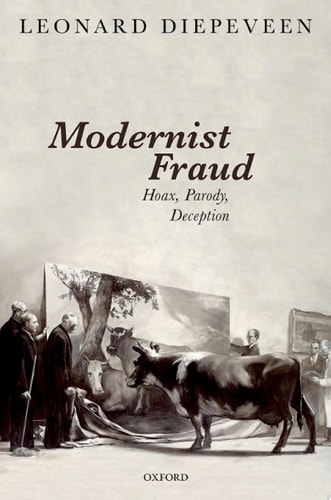
Modernist Fraud: Hoax, Parody, Deception
0
0
As an Amazon Associate and affiliate partner, Menrva Books earns from qualifying purchases. Learn more
Author Description
Focusing on literature and visual art in the years 1910-1935, Modernist Fraud begins with the omnipresent accusations that modernism was not art at all, but rather an effort to pass off patently absurd works as great art. These assertions, common in the time's journalism, are used to understand the aesthetic and context which spawned them, and to look at what followed in their wake. Fraud discourse ventured into the aesthetic theory of the time, to ideas of artistic sincerity, formalism, and the intentional fallacy. In doing so, it profoundly shaped the modern canon and its justifying principles. Modernist Fraud explores a wide range of materials. It draws on reviews and newspaper accounts of art scandals, such as the 1913 Armory Show, the 1910 and 1912 Postimpressionist shows, and Tender Buttons; to daily syndicated columns; to parodies and doggerel; to actual hoaxes, such as Spectra and Disumbrationism; to the literary criticism of Edith Sitwell; to the trial of Brancusi's Bird in Space; and to the contents of the magazine Blind Man, including a defense of Duchamp's Fountain, a poem by Bill Brown, and the works of, and an interview with, the bafflingly unstable painter Louis Eilshemius. In turning to these materials, the book reevaluates how modernism interacted with the public and describes how a new aesthetic begins: not as a triumphant explosion that initiates irrevocable changes, but as an uncertain muddling and struggle with ideology.
Menrva's Summary
THE THESIS
This book investigates how accusations of fraud and deception directed at modernist works between 1910 and 1935 fundamentally shaped the development of the modernist canon and its aesthetic principles. Leonard Diepeveen, a scholar of modernist literature and culture, utilizes a wide array of historical documents to argue that modernism did not emerge as a singular, triumphant movement, but rather through a messy, contentious struggle with public perception and ideological skepticism. By examining the discourse surrounding art scandals, the author demonstrates how these accusations forced modernists to refine their theories of sincerity, formalism, and artistic intent.
THE SCOPE MAP
What You Will Find
- Analysis of major art scandals including the 1913 Armory Show and the 1910/1912 Postimpressionist exhibitions.
- Examination of specific hoaxes such as Spectra and Disumbrationism.
- Discussion of legal and critical responses to works like Brancusi's Bird in Space and Duchamp's Fountain.
- Exploration of contemporary journalism, parodies, and doggerel as primary sources for understanding public reception.
Scope Limits
- The analysis is strictly confined to the period between 1910 and 1935.
- The book focuses primarily on the intersection of literature and visual art, excluding broader sociological impacts outside the art world.
THE AUTHORITY PERSPECTIVE
Scholars and critics recognize this work as a significant contribution to the study of modernist reception history, noting its meticulous use of archival materials. Readers frequently highlight the academic density of the prose, which is well-suited for researchers interested in the intersection of aesthetic theory and public controversy.
Page Count:
221
Publication Date:
2019-01-01
Publisher:
OUP Oxford
ISBN-10:
0192559370
ISBN-13:
9780192559371
History
Literary Criticism
Aesthetics
Modernism Art
Art History
Indigenous
Modernism
Modernism aesthetics
Community Tags
Similar Books