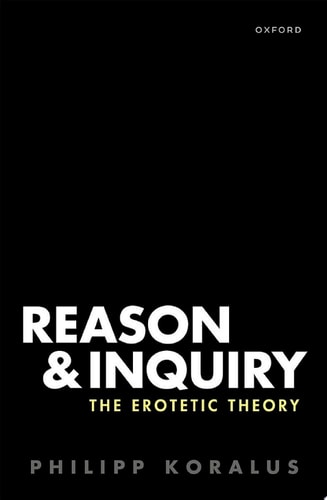
Reason and Inquiry: The Erotetic Theory
0
0
As an Amazon Associate and affiliate partner, Menrva Books earns from qualifying purchases. Learn more
Author Description
Reason and Inquiry: The Erotetic Theory presents a unified theory of the human capacity for reasoning and decision-making. The erotetic theory accounts for a diverse range of empirically documented fallacies and framing effects. It shows how the same mental processes that yield fallacies can yield what logicians call first-order validity and probabilistic coherence in reasoning, as well as rational decision-making as conceived by economists. The book's central idea is that our minds naturally aim at resolving issues, and if we are sufficiently inquisitive in the process, we can avoid mistakes. The erotetic theory holds that both the successes and the failures of reason are due to this aim. Rationality is secured if we reach what is described by the theory as erotetic equilibrium.
Menrva's Summary
THE THESIS
This book investigates the core question of how human reasoning and decision-making can be unified under a single theoretical framework. Philipp Koralus, a researcher in cognitive science and philosophy, utilizes empirical data on cognitive fallacies and framing effects to argue that human cognition is fundamentally driven by the pursuit of resolving issues. He posits that both rational successes and logical failures stem from this same underlying mechanism, which he terms erotetic equilibrium.
THE SCOPE MAP
What You Will Find
- A comprehensive framework for understanding human reasoning as an issue-resolution process
- Analysis of documented cognitive fallacies and framing effects
- Integration of logical validity with economic models of rational decision-making
Scope Limits
- The text does not provide a general history of logic or a survey of all competing psychological theories of reasoning
- It focuses primarily on the erotetic model rather than neurobiological mechanisms of the brain
THE AUTHORITY PERSPECTIVE
Experts in cognitive science and philosophy recognize this work as a significant contribution to the study of human rationality. Readers frequently note the academic density of the prose, which requires a strong background in formal logic and cognitive psychology to fully grasp the proposed equilibrium model.
Page Count:
366
Publication Date:
2023-01-01
Publisher:
OUP Oxford
ISBN-10:
0192557017
ISBN-13:
9780192557018
Philosophy
Decision Theory
Logic
Epistemology
Mind & Body
Community Tags
Similar Books