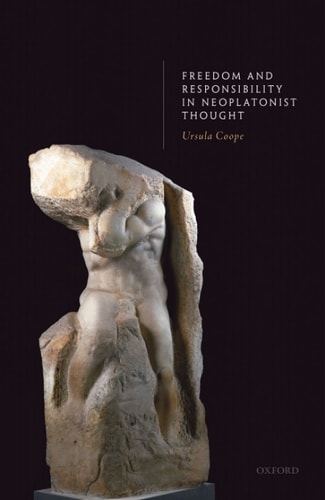
Freedom and Responsibility in Neoplatonist Thought
0
0
As an Amazon Associate and affiliate partner, Menrva Books earns from qualifying purchases. Learn more
Author Description
The Neoplatonists have a perfectionist view of freedom: an entity is free to the extent that it succeeds in making itself good. Free entities are wholly in control of themselves--they are self-determining, self-constituting, and self-knowing. Neoplatonist philosophers argue that such freedom is only possible for non-bodily things. The human soul is free insofar as it rises above bodily things and engages in intellection, but when it turns its desires to bodily things, it is drawn under the sway of fate and becomes enslaved. Ursula Coope discusses this notion of freedom and its relation to questions about responsibility. She explains the important role of notions of self-reflexivity in Neoplatonist accounts of both freedom and responsibility. In Part I, Coope sets out the puzzles Neoplatonist philosophers face about freedom and responsibility and explains how these puzzles arise from earlier discussions. Part II explores the metaphysical underpinnings of the Neoplatonist notion of freedom (concentrating especially on the views of Plotinus and Proclus). In what sense, if any, is the ultimate first principle of everything (the One) free? If everything else is under this ultimate first principle, how can anything other than the One be free? What is the connection between freedom and nonbodiliness? Finally, Coope considers in Part III questions about responsibility, arising from this perfectionist view of freedom. Why are human beings responsible for their behaviour, in a way that other animals are not? If we are enslaved when we act viciously, how can we be to blame for our vicious actions and choices?
Menrva's Summary
THE THESIS
This work investigates the Neoplatonist conception of freedom as a perfectionist state and its subsequent implications for moral responsibility. Ursula Coope, a scholar of ancient philosophy, examines how Neoplatonist thinkers define freedom through self-determination and self-knowledge. By analyzing the metaphysical divide between bodily and non-bodily existence, the author constructs a framework that addresses how human souls navigate the tension between intellectual autonomy and the constraints of fate.
THE SCOPE MAP
What You Will Find
- A detailed analysis of the metaphysical foundations of freedom in the works of Plotinus and Proclus.
- An exploration of the relationship between self-reflexivity and moral agency.
- A structured examination of the paradoxes surrounding the One and the freedom of subordinate entities.
Scope Limits
- The text focuses primarily on the Neoplatonist tradition and does not provide a comprehensive survey of modern libertarian or compatibilist theories of free will.
- The analysis is restricted to the specific perfectionist framework of the Neoplatonists rather than broader ethical systems.
THE AUTHORITY PERSPECTIVE
Scholars frequently cite this text as a rigorous examination of the intersection between Neoplatonist metaphysics and ethics. Readers often note the academic density of the prose, which is intended for those with a background in classical philosophy.
Page Count:
304
Publication Date:
2020-01-01
Publisher:
OUP Oxford
ISBN-10:
0192558285
ISBN-13:
9780192558282
Philosophy
Metaphysics
History & Surveys
Neoplatonism
Ethics
Philosophy history