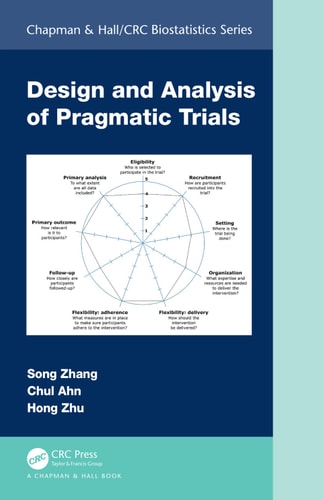
Design and Analysis of Pragmatic Trials
0
0
As an Amazon Associate and affiliate partner, Menrva Books earns from qualifying purchases. Learn more
Author Description
This book begins with an introduction of pragmatic cluster randomized trials (PCTs) and reviews various pragmatic issues that need to be addressed by statisticians at the design stage. It discusses the advantages and disadvantages of each type of PCT, and provides sample size formulas, sensitivity analyses, and examples for sample size calculation. The generalized estimating equation (GEE) method will be employed to derive sample size formulas for various types of outcomes from the exponential family, including continuous, binary, and count variables. Experimental designs that have been frequently employed in PCTs will be discussed, including cluster randomized designs, matched-pair cluster randomized design, stratified cluster randomized design, stepped-wedge cluster randomized design, longitudinal cluster randomized design, and crossover cluster randomized design. It demonstrates that the GEE approach is flexible to accommodate pragmatic issues such as hierarchical correlation structures, different missing data patterns, randomly varying cluster sizes, etc. It has been reported that the GEE approach leads to under-estimated variance with limited numbers of clusters. The remedy for this limitation is investigated for the design of PCTs. This book can assist practitioners in the design of PCTs by providing a description of the advantages and disadvantages of various PCTs and sample size formulas that address various pragmatic issues, facilitating the proper implementation of PCTs to improve health care. It can also serve as a textbook for biostatistics students at the graduate level to enhance their knowledge or skill in clinical trial design. Key Features: Discuss the advantages and disadvantages of each type of PCTs, and provide sample size formulas, sensitivity analyses, and examples. Address an unmet need for guidance books on sample size calculations for PCTs; A wide variety of experimental designs adopted by PCTs are covered; The sample size solutions can be r
Menrva's Summary
THE THESIS
This book investigates the design and analysis of pragmatic clinical trials (PCTs), focusing on the statistical considerations crucial for their successful implementation. It addresses the need for statisticians to navigate various pragmatic issues during the design phase, detailing the advantages and disadvantages of different PCT types. The work provides essential sample size formulas, sensitivity analyses, and practical examples, employing the generalized estimating equation (GEE) method to derive formulas for diverse outcome types. It also explores a range of experimental designs commonly used in PCTs, demonstrating the flexibility of the GEE approach in handling complex issues like hierarchical correlations, missing data, and varying cluster sizes, while also addressing limitations such as under-estimated variance with few clusters.
THE SCOPE MAP
- Introduction to pragmatic cluster randomized trials (PCTs) and their design considerations.
- Discussion of the advantages and disadvantages of various PCT types.
- Sample size formulas, sensitivity analyses, and calculation examples.
- Application of the generalized estimating equation (GEE) method for continuous, binary, and count outcomes.
- Coverage of experimental designs: cluster randomized, matched-pair cluster randomized, stratified cluster randomized, stepped-wedge cluster randomized, longitudinal cluster randomized, and crossover cluster randomized designs.
- Demonstration of GEE's flexibility for hierarchical correlation structures, missing data, and varying cluster sizes.
- Investigation into remedies for under-estimated variance with limited numbers of clusters in PCT design.
- Guidance for practitioners and a textbook resource for graduate biostatistics students.
THE AUTHORITY PERSPECTIVE
This book is designed to assist practitioners in the design of PCTs by offering a clear description of various PCT advantages and disadvantages, alongside sample size formulas that account for pragmatic issues. It aims to facilitate the proper implementation of PCTs to enhance healthcare outcomes. Furthermore, it is intended to serve as a valuable textbook for graduate-level biostatistics students, aiming to deepen their understanding and skills in clinical trial design. The text addresses a specific need for guidance on sample size calculations within the context of PCTs.
Page Count:
336
Publication Date:
2023-05-16
Publisher:
Taylor & Francis
ISBN-10:
1000873587
ISBN-13:
9781000873580
Non-Fiction
Science
Community Tags
Other Editions(4)
Similar Books












Reader Comments
Share Your Thoughts
No comments yet. Be the first to share your thoughts!