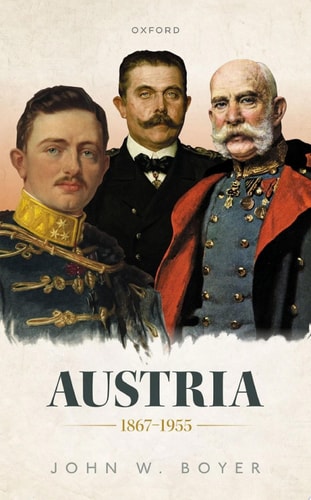
Austria 1867-1955: Oxford History of Modern Europe
0
0
As an Amazon Associate and affiliate partner, Menrva Books earns from qualifying purchases. Learn more
Author Description
Austria 1867-1955 connects the political history of German-speaking provinces of the Habsburg Empire before 1914 (Vienna and the Alpine Lands) with the history of the Austrian Republic that emerged in 1918. John W. Boyer presents the case of modern Austria as a fascinating example of democratic nation-building. The construction of an Austrian political nation began in 1867 under Habsburg Imperial auspices, with the German-speaking bourgeois Liberals defining the concept of a political people (Volk) and giving that Volk a constitution and a liberal legal and parliamentary order to protect their rights against the Crown. The decades that followed saw the administrative and judicial institutions of the Liberal state solidified, but in the 1880s and 1890s the membership of the Volk exploded to include new social and economic strata from the lower bourgeoisie and the working classes. Ethnic identity was not the final structuring principle of everyday politics, as it was in the Czech lands. Rather social class, occupational culture, and religion became more prominent variables in the sortition of civic interests, exemplified by the emergence of two great ideological parties, Christian Socialism and Social Democracy in Vienna in the 1890s. The war crisis of 1914/1918 exploded the Empire, with the Crown self-destructing in the face of military defeat, chronic domestic unrest, and bitter national partisanship. But this crisis also accelerated the emergence of new structures of democratic self-governance in the German-speaking Austrian lands, enshrined in the republican Constitution of 1920. Initial attempts to make this new project of democratic nation-building work failed in the 1920s and 1930s, culminating in the catastrophe of the 1938 Nazi occupation. After 1945 the surviving legatees of the Revolution of 1918 reassembled under the four-power Allied occupation, which fashioned a shared political culture which proved sufficiently flexible to accommodate intense partisansh
Menrva's Summary
THE THESIS
This work investigates the complex evolution of democratic nation-building within the German-speaking provinces of the Habsburg Empire and the subsequent Austrian Republic. John W. Boyer, a distinguished historian of Central Europe, utilizes extensive archival research and political analysis to trace how administrative, judicial, and ideological structures transitioned from imperial rule to republican governance. The text argues that the formation of the Austrian political nation was driven by shifting social classes, occupational cultures, and religious identities rather than purely ethnic nationalism.
THE SCOPE MAP
What You Will Find
- Analysis of the transition from the Habsburg Empire to the Austrian Republic.
- Examination of the role of Christian Socialism and Social Democracy in shaping political identity.
- Evaluation of the 1920 Constitution and the impact of the 1938 Nazi occupation.
- Discussion of post-1945 political culture under Allied occupation.
Scope Limits
- The text focuses primarily on the German-speaking provinces of the Habsburg Empire.
- It does not provide an exhaustive military history of the World Wars.
THE AUTHORITY PERSPECTIVE
Scholars and historians recognize this volume as a definitive account of the political development of modern Austria. Readers frequently note the academic density of the prose, which provides a rigorous and comprehensive framework for understanding the region's complex institutional history.
Page Count:
1147
Publication Date:
2022-01-01
Publisher:
OUP Oxford
ISBN-10:
0192561774
ISBN-13:
9780192561770
History
Modern History
Political History
European History
Europe
Austrian History
Community Tags
Similar Books