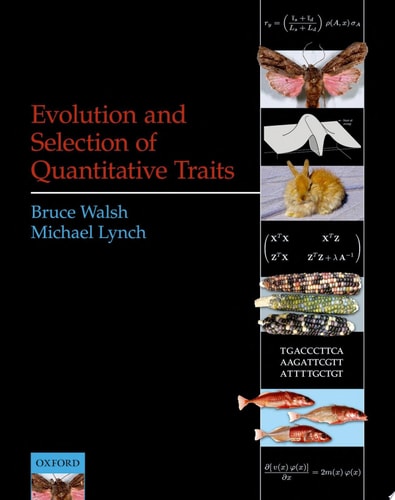
Evolution and Selection of Quantitative Traits
0
0
As an Amazon Associate and affiliate partner, Menrva Books earns from qualifying purchases. Learn more
Author Description
Quantitative traits-be they morphological or physiological characters, aspects of behavior, or genome-level features such as the amount of RNA or protein expression for a specific gene-usually show considerable variation within and among populations. Quantitative genetics, also referred to as the genetics of complex traits, is the study of such characters and is based on mathematical models of evolution in which many genes influence the trait and in which non-genetic factors may also be important. Evolution and Selection of Quantitative Traits presents a holistic treatment of the subject, showing the interplay between theory and data with extensive discussions on statistical issues relating to the estimation of the biologically relevant parameters for these models. Quantitative genetics is viewed as the bridge between complex mathematical models of trait evolution and real-world data, and the authors have clearly framed their treatment as such. This is the second volume in a planned trilogy that summarizes the modern field of quantitative genetics, informed by empirical observations from wide-ranging fields (agriculture, evolution, ecology, and human biology) as well as population genetics, statistical theory, mathematical modeling, genetics, and genomics. Whilst volume 1 (1998) dealt with the genetics of such traits, the main focus of volume 2 is on their evolution, with a special emphasis on detecting selection (ranging from the use of genomic and historical data through to ecological field data) and examining its consequences.
Menrva's Summary
THE THESIS
This volume investigates the mechanisms of evolution and selection acting upon complex, quantitative traits within biological populations. Authors Bruce Walsh and Michael J. Lynch synthesize mathematical modeling with empirical data to provide a comprehensive framework for understanding how multiple genes and environmental factors influence phenotypic variation. The text serves as a bridge between theoretical population genetics and the practical application of statistical methods in fields ranging from agriculture to human biology.
THE SCOPE MAP
What You Will Find
- Mathematical models for trait evolution and selection
- Statistical methodologies for estimating biologically relevant parameters
- Empirical evidence from agriculture, ecology, and genomics
- Analysis of selection detection using historical and field data
Scope Limits
- Does not cover the foundational genetics of traits, which was the primary focus of the first volume in the trilogy
- Excludes basic introductory concepts for readers without a background in population genetics or advanced statistics
THE AUTHORITY PERSPECTIVE
Experts recognize this work as a rigorous and comprehensive reference for researchers and graduate students in evolutionary biology. Readers frequently note the high level of mathematical and statistical density required to fully engage with the authors' arguments.
Page Count:
1496
Publication Date:
2018-01-01
Publisher:
OUP Oxford
ISBN-10:
0192566644
ISBN-13:
9780192566645
Science
Mathematics
Biology
Genetics
Evolutionary Biology
Community Tags
Similar Books