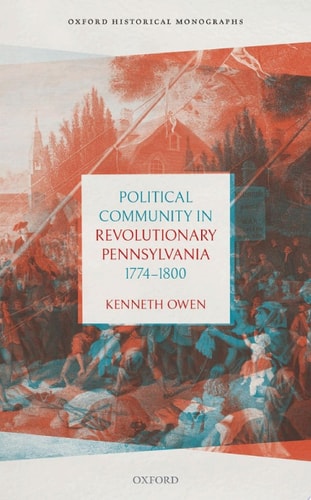
Political Community in Revolutionary Pennsylvania, 1774-1800
0
0
As an Amazon Associate and affiliate partner, Menrva Books earns from qualifying purchases. Learn more
Author Description
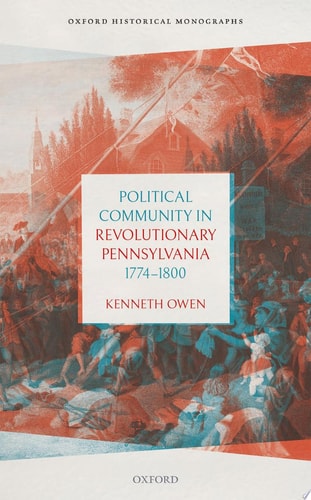
Political Community in Revolutionary Pennsylvania challenges the ways we understand popular sovereignty in the American Revolution. Whereas previous histories place undue focus on elite political thought or analysis based on class, this study argues that it was ordinary citizens that cared most about the establishment of a proper, representative, publicly legitimate political process. Popular activism constrained the options available to leaders and created a system through which the actions of government were made more representative of the will of the community. Political Community in Revolutionary Pennsylvania analyzes political developments in Pennsylvania from 1774, when Americans united in opposition to Britain's Intolerable Acts, through to 1800 and the election of Thomas Jefferson. It looks at the animating philosophy of the Pennsylvania state constitution of 1776, a 'radical manifesto' which espoused a vision of popular sovereignty in which government was devolved from the people only where necessary. Even when governmental institutions were necessary, their legitimacy rested on being able to clearly demonstrate that they operated on popular consent, expressed in a variety of forms of popular mobilization.
Menrva's Summary
THE THESIS
This study investigates how ordinary citizens, rather than elite political actors, shaped the development of popular sovereignty and representative government in Pennsylvania during the American Revolution. Kenneth Owen, a scholar of early American history, utilizes a wide array of primary sources to challenge traditional historiography that emphasizes class-based analysis or elite intellectual history. He argues that popular activism functioned as a critical constraint on leadership, ensuring that governmental legitimacy remained tethered to the expressed consent of the community.
THE SCOPE MAP
What You Will Find
- Analysis of the Pennsylvania state constitution of 1776 as a radical manifesto of popular sovereignty.
- Examination of political mobilization patterns from 1774 through the election of 1800.
- Evaluation of the tension between devolved government and centralized institutional authority.
Scope Limits
- The study is geographically confined to the state of Pennsylvania.
- It does not provide a comprehensive national history of the American Revolution, focusing instead on the specific regional political culture of the period.
THE AUTHORITY PERSPECTIVE
Historians recognize this work as a significant contribution to the study of early American political culture and the mechanics of revolutionary governance. Scholars frequently note the author's ability to synthesize complex archival data into a coherent argument regarding the role of non-elite actors in the formation of democratic institutions.
Page Count:
217
Publication Date:
2018-01-01
Publisher:
OUP Oxford
ISBN-10:
0192563033
ISBN-13:
9780192563033
History
Revolutionary War
United States
Political Philosophy
American History