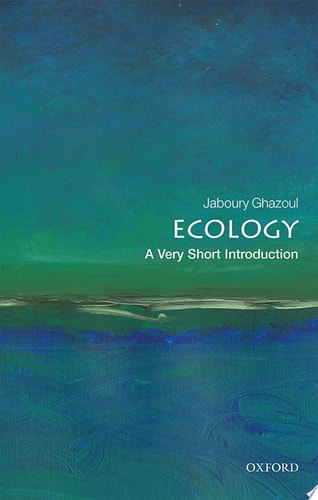
Ecology: A Very Short Introduction
0
0
As an Amazon Associate and affiliate partner, Menrva Books earns from qualifying purchases. Learn more
Author Description
Understanding how our living environment works is essentially a study of ecological systems. Ecology is the science of how organisms interact with each other and with their environment, and how such interactions create self-organising communities and ecosystems. This science touches us all. The food we eat, the water we drink, the natural resources we use, our physical and mental health, and much of our cultural heritage are to a large degree products of ecological interactions of organisms and their environment. This Very Short Introduction celebrates the centrality of ecology in our lives. Jaboury Ghazoul explores how ecology has evolved rapidly from natural history to become a predictive science that explains how the natural world works, and which guides environmental policy and management decisions. Drawing on a range of examples, he shows how ecological science can be applied to management and conservation, including the extent to which theory has shaped practice. Ecological science has also shaped social and cultural perspectives on the environment, a process that influences politics of the environment. Ghazoul concludes by considering the future of ecology, particularly in the light of current and future environmental challenges. ABOUT THE SERIES: The Very Short Introductions series from Oxford University Press contains hundreds of titles in almost every subject area. These pocket-sized books are the perfect way to get ahead in a new subject quickly. Our expert authors combine facts, analysis, perspective, new ideas, and enthusiasm to make interesting and challenging topics highly readable.
Menrva's Summary
THE THESIS
This book investigates the fundamental principles of ecology and its evolution from a descriptive study of natural history into a predictive science essential for environmental management. Jaboury Ghazoul, a professor of ecosystem management, utilizes his expertise to explain how ecological interactions dictate the structure of communities and ecosystems. The text argues that ecology is not merely an academic discipline but a critical framework for understanding human survival, resource management, and the development of environmental policy.
THE SCOPE MAP
What You Will Find
- Historical evolution of ecological thought
- Analysis of organism-environment interactions
- Applications of ecological theory in conservation and management
- Discussion on the intersection of ecology, politics, and social culture
Scope Limits
- Does not provide an exhaustive technical manual for field research
- Does not cover specific regional flora or fauna in deep detail
THE AUTHORITY PERSPECTIVE
Experts and readers recognize this text as a concise, accessible entry point into the complexities of ecological science. The prose is noted for its clarity, making dense scientific concepts digestible for students and interested laypeople alike.
Page Count:
184
Publication Date:
2020-01-01
Publisher:
OUP Oxford
ISBN-10:
019256675X
ISBN-13:
9780192566751
Non-Fiction
Science
Nature
Ecology
Biology
Nature