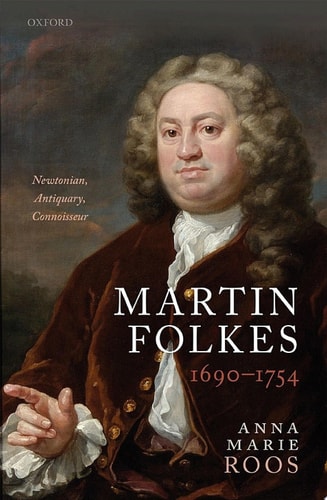
Martin Folkes (1690-1754): Newtonian, Antiquary, Connoisseur
0
0
As an Amazon Associate and affiliate partner, Menrva Books earns from qualifying purchases. Learn more
Author Description
Martin Folkes (1690-1754): Newtonian, Antiquary, Connoisseur is a cultural and intellectual biography of the only President of both the Royal Society and the Society of Antiquaries. Sir Isaac Newton's protégé, astronomer, mathematician, freemason, art connoisseur, Voltaire's friend and Hogarth's patron, his was an intellectually vibrant world. Folkes was possibly the best-connected natural philosopher and antiquary of his age, an epitome of Enlightenment sociability, and yet he was a surprisingly neglected figure, the long shadow of Newton eclipsing his brilliant disciple. A complex figure, Folkes edited Newton's posthumous works in biblical chronology, yet was a religious skeptic and one of the first members of the gentry to marry an actress. His interests were multidisciplinary, from his authorship of the first complete history of the English coinage, to works concerning ancient architecture, statistical probability, and astronomy. Rich archival material, including Folkes's travel diary, correspondence, and his library and art collections permit reconstruction through Folkes's eyes of what it was like to be a collector and patron, a Masonic freethinker, and antiquarian and virtuoso in the days before 'science' became sub-specialised. Folkes's virtuosic sensibility and possible role in the unification of the Society of Antiquaries and the Royal Society tells against the historiographical assumption that this was the age in which the 'two cultures' of the humanities and sciences split apart, never to be reunited. In Georgian England, antiquarianism and 'science' were considered largely part of the same endeavour.
Menrva's Summary
THE THESIS
This biography investigates the life and intellectual contributions of Martin Folkes, a central figure in the Enlightenment who served as president of both the Royal Society and the Society of Antiquaries. Anna Marie Roos, a historian of science, utilizes extensive archival research—including personal correspondence, travel diaries, and collection inventories—to reconstruct Folkes's multifaceted career. The book argues that Folkes serves as a critical case study for understanding the synthesis of scientific and humanistic inquiry in Georgian England, challenging the narrative that these fields were already bifurcated during his lifetime.
THE SCOPE MAP
What You Will Find
- Detailed analysis of Folkes's role as a protégé of Isaac Newton and his subsequent leadership in major scientific and antiquarian societies.
- Examination of his diverse intellectual output, ranging from numismatics and statistical probability to biblical chronology and astronomy.
- Insights into the social and cultural networks of the 18th-century British elite, including his connections to Voltaire and Hogarth.
Scope Limits
- The text does not provide a comprehensive history of the Royal Society beyond its intersection with Folkes's tenure.
- It does not offer a technical deep-dive into the specific mathematical proofs of his scientific papers, focusing instead on his broader intellectual and cultural impact.
THE AUTHORITY PERSPECTIVE
Scholars recognize this work as a significant contribution to the history of the Enlightenment, particularly for its success in rescuing a neglected figure from the shadow of Newton. Readers frequently note the academic density of the prose, which provides a rigorous examination of the interconnectedness of 18th-century intellectual life.
Page Count:
428
Publication Date:
2021-01-01
Publisher:
OUP Oxford
ISBN-10:
0192565656
ISBN-13:
9780192565655
Biography
History
Intellectual History
Earth Sciences
Enlightenment
Science History
Antiquarianism
Community Tags
Similar Books