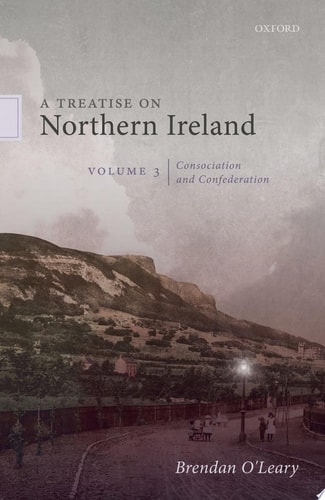
A Treatise on Northern Ireland: Volume III
0
0
As an Amazon Associate and affiliate partner, Menrva Books earns from qualifying purchases. Learn more
Author Description
The Good Friday Agreement deserved the attention the world gave it, even if it was not always accurately understood. After its ratification in two referendums, for the first time in history political institutions throughout the island of Ireland rested upon the freely given assent of majorities of all the peoples on the island. It marked, it was hoped, the full political decolonization of Ireland. Whether Ireland would reunify, or whether Northern Ireland remain in union with Great Britain now rested on the will of the people of Ireland, North and South respectively: a complex mode of power-sharing addressed the self-determination dispute. The concluding volume of Brendan O'Leary's A Treatise on Northern Ireland explains the making of this settlement, and the many failed initiatives that preceded it under British direct rule. Long-term structural and institutional changes and short-term political maneuvers are given their due in this lively but comprehensive assessment. The Anglo-Irish Agreement is identified as the political tipping point, itself partially the outcome of the hunger strikes of 1980-81 that had prevented the criminalization of republicanism. Until 2016 the prudent judgment seemed to be that the Good Friday Agreement had broadly worked, eventually enabling Sinn Féin and the DUP to share power, with intermittent attention from the sovereign governments. Cultural Catholics appeared content if not in love with the Union with Great Britain. But the decision to hold a referendum on the UK's membership of the European Union has collaterally damaged and destabilized the Good Friday Agreement. That, in turn, has shaped the UK's tortured exit negotiations with the European Union. In appraising these recent events and assessing possible futures, readers will find O'Leary's distinctive angle of vision clear, sharp, unsentimental, and unsparing of reputations, in keeping with the mastery of the historical panoramas displayed throughout this treatise.
Menrva's Summary
THE THESIS
This volume investigates the political evolution, structural failures, and eventual settlement of the Northern Ireland conflict, specifically focusing on the transition from British direct rule to the Good Friday Agreement. Brendan O'Leary, a prominent political scientist, utilizes extensive historical analysis and institutional theory to evaluate the mechanisms of power-sharing and the impact of the Anglo-Irish Agreement. The work argues that while the Good Friday Agreement provided a framework for stability, the 2016 Brexit referendum introduced significant destabilizing pressures that continue to challenge the region's political future.
THE SCOPE MAP
What You Will Find
- Detailed analysis of the transition from British direct rule to power-sharing institutions.
- Examination of the Anglo-Irish Agreement as a critical political tipping point.
- Assessment of the impact of the 1980-81 hunger strikes on republican politics.
- Evaluation of the destabilizing effects of the UK's exit from the European Union on the Good Friday Agreement.
Scope Limits
- The text focuses primarily on political and institutional history rather than social or cultural history.
- The analysis is bounded by the author's specific focus on constitutional and power-sharing frameworks.
THE AUTHORITY PERSPECTIVE
Scholars and political analysts recognize this work as a definitive, high-density examination of the Northern Irish peace process. Readers frequently note the academic rigor and the author's uncompromising, analytical approach to historical events and political reputations.
Page Count:
576
Publication Date:
2019-01-01
Publisher:
Oxford University Press
ISBN-10:
0192566326
ISBN-13:
9780192566324
History
Northern Ireland
British History
Government
International relations
Community Tags
Similar Books