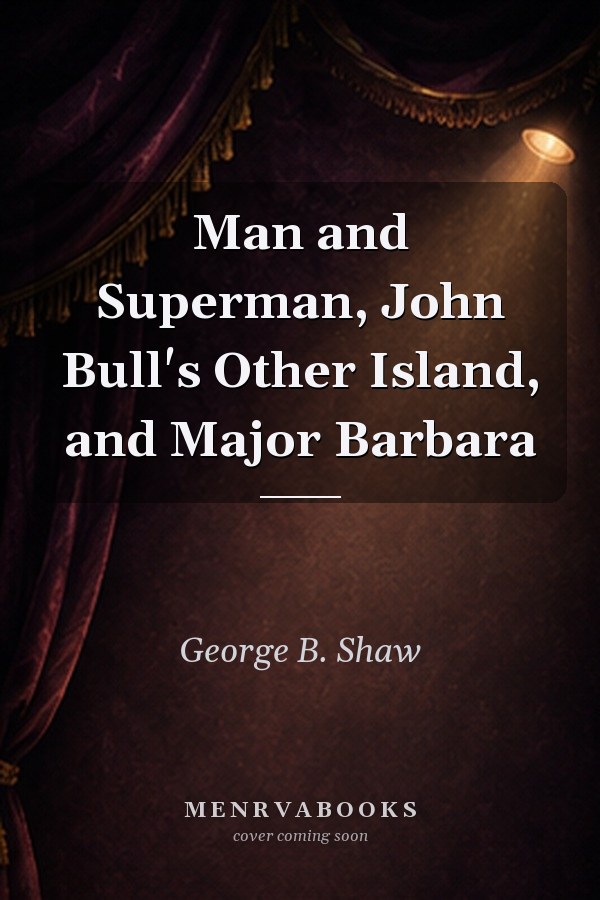
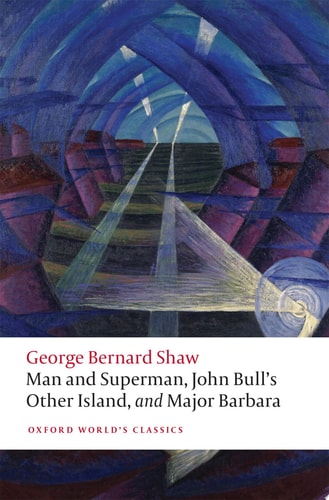
Man and Superman, John Bull's Other Island, and Major Barbara
0
0
As an Amazon Associate and affiliate partner, Menrva Books earns from qualifying purchases. Learn more
Author Description
Nobel Laureate George Bernard Shaw remains one of the world's most important and popular writers. His plays are regularly performed around the world, from the boards of Broadway and the West End to regional, community, and college stages. The three plays selected here are widely considered to be three of the most important in the canon of modern British theatre: Man and Superman: A four-act comedy for serious people, staged in part at Royal Court in 1905, it is one of the early works of modernism to take an ancient myth and restage it in contemporary mode (and its influence extends across world literature, palpable in writings from Mann to Joyce). Its story of how a sensitive woman compels a superman-figure to adjust to her needs and those of the real world provides an updated commentary on Nietzsche's still-fashionable notions of Ubermensch; and its famous third act introduces a persistent Shavian theme, which goes back as far as earliest religious literature-that the truly damned are those who are happy in Hell. John Bull's Other Island takes up that idea: to the visionary, Hell may be the ultimate modern dream of efficiency and rational administration, as manifested in a colonial Ireland run by liberal exploiters. Commissioned by WB Yeats to mark the opening of Ireland's National Theatre, the Abbey, the play was promptly refused by its directors (who disliked its mechanical mockeries of mechanism but may have missed its visionary qualities). It was performed to huge acclaim in London in November 1904 and it made Shaw famous, the supreme example of the playwright as thinker and, ever afterwards, one of the most valued commentators on Anglo-Irish relations. Major Barbara: A three-act drama which in classic Shavian style unmasks the motivation of Puritan idealists and dedicated industrialists, this work (like the previous two) pits a strong woman against a sardonic, practical man. Having exposed the mendacity of apostles of efficiency, Shaw seems then to submit to t
Menrva's Summary
THE PULSE
These three plays examine the friction between individual idealism and the rigid structures of modern society. Each work features a strong-willed protagonist navigating social, political, or philosophical constraints, often challenging the status quo through sharp, intellectual dialogue. Shaw employs a distinct narrative framework where characters serve as mouthpieces for competing ideologies, forcing the audience to confront the contradictions of morality, religion, and governance. The physical settings range from the drawing rooms of the British elite to the colonial landscapes of Ireland, providing a backdrop for the characters' logical and ethical confrontations.
INSIDE THE PAGES
- Use of the 'Shavian' dialectic to debate philosophical concepts
- Satirical examination of Nietzschean philosophy and the Ubermensch
- Exploration of Anglo-Irish political tensions and colonial administration
- Critique of Puritan idealism versus industrial pragmatism
- Strong female protagonists who actively shape their own destinies
- Integration of mythic archetypes into contemporary settings
- Focus on the irony of social efficiency and rationalism
- Multi-act structures designed for theatrical performance
THE COLLECTIVE ECHO
Readers and critics frequently highlight Shaw's ability to balance intellectual rigor with biting wit, noting that his plays function as much as social treatises as they do entertainment. Discussion often centers on the playwright's skill in creating characters who represent opposing viewpoints, allowing for a nuanced exploration of complex moral dilemmas. Many observers point to the enduring relevance of his critiques regarding institutional power and the hypocrisy of the ruling class. The pacing is often described as dialogue-heavy, which rewards readers who appreciate dense, argumentative prose over traditional action-oriented narratives. Scholars consistently emphasize these works as foundational texts for understanding the evolution of modern British theatre.
Page Count:
288
Publication Date:
2021-01-01
Publisher:
Oxford University Press
ISBN-10:
0192563971
ISBN-13:
9780192563972
Drama
British literature
Classic Literature
Comedy
Plays
Social Commentary
Community Tags
Other Editions(2)
Similar Books

Reader Comments
Share Your Thoughts
No comments yet. Be the first to share your thoughts!