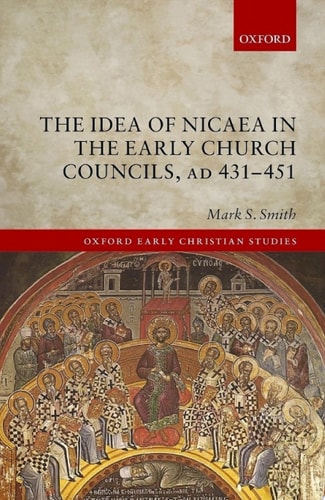
The Idea of Nicaea in the Early Church Councils, AD 431-451
0
0
As an Amazon Associate and affiliate partner, Menrva Books earns from qualifying purchases. Learn more
Author Description
The Idea of Nicaea in the Early Church Councils examines the role that appeals to Nicaea (both the council and its creed) played in the major councils of the mid-fifth century. It argues that the conflict between rival construals of Nicaea, and the struggle convincingly to arbitrate between them, represented a key dynamic driving--and unsettling--the conciliar activity of these decades. Mark S. Smith identifies a set of inherited assumptions concerning the role that Nicaea was expected to play in orthodox discourse--namely, that it possessed unique authority as a conciliar event, and sole sufficiency as a credal statement. The fundamental dilemma was thus how such shibboleths could be persuasively reaffirmed in the context of a dispute over Christological doctrine that the resources of the Nicene Creed were inadequate to address, and how the convening of new oecumenical councils could avoid fatally undermining Nicaea's special status. Smith examines the articulation of these contested ideas of 'Nicaea' at the councils of Ephesus I (431), Constantinople (448), Ephesus II (449), and Chalcedon (451). Particular attention is paid to the role of conciliar acta in providing carefully-shaped written contexts within which the Nicene Creed could be read and interpreted. This study proposes that the capacity of the idea of 'Nicaea' for flexible re-expression was a source of opportunity as well as a cause of strife, allowing continuity with the past to be asserted precisely through adaptation and modification, and opening up significant new paths for the articulation of credal and conciliar authority. The work thus combines a detailed historical analysis of the reception of Nicaea in the proceedings of the fifth-century councils, with an examination of the complex delineation of theological 'orthodoxy' in this period. It also reflects more widely on questions of doctrinal development and ecclesial reception in the early church.
Menrva's Summary
THE THESIS
This study investigates how the Council of Nicaea and its creed functioned as a central, contested authority during the major church councils of the mid-fifth century. Mark S. Smith, a scholar of early Christian history, analyzes how ecclesiastical leaders navigated the tension between maintaining Nicaea's unique status and addressing new Christological disputes that the original creed could not resolve. He argues that the flexibility of the 'Idea of Nicaea' allowed for both continuity and necessary doctrinal adaptation during this volatile period.
THE SCOPE MAP
What You Will Find
- Historical analysis of the councils of Ephesus I (431), Constantinople (448), Ephesus II (449), and Chalcedon (451)
- Examination of conciliar acta as tools for shaping theological interpretation
- Exploration of the development of orthodoxy and ecclesial reception
Scope Limits
- The study focuses specifically on the mid-fifth century and does not provide a comprehensive history of the Nicene Creed beyond this era
- The text prioritizes the procedural and rhetorical use of Nicaea over broader social or political histories of the period
THE AUTHORITY PERSPECTIVE
Scholars and historians of late antiquity recognize this work as a rigorous examination of the mechanics of conciliar authority and doctrinal development. Readers frequently note the academic density of the prose, which is intended for those with a background in patristic studies or church history.
Page Count:
244
Publication Date:
2018-01-01
Publisher:
OUP Oxford
ISBN-10:
0192572156
ISBN-13:
9780192572158
History
Religion
Christianity
Theology
Patristics
Church History
Community Tags
Other Editions(2)
Similar Books

Reader Comments
Share Your Thoughts
No comments yet. Be the first to share your thoughts!