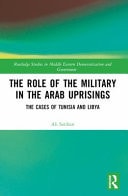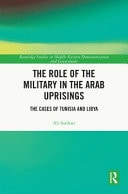
The Role of the Military in the Arab Uprisings: The Cases of Tunisia and Libya
0
0
As an Amazon Associate and affiliate partner, Menrva Books earns from qualifying purchases. Learn more
Author Description
Focused on the 2010-2011 Arab Uprisings, this book examines the role of the military in Tunisia and Libya, arguing that both armies contributed decisively to the outcome and form of the respective uprisings. The book begins by contextualising the uprisings, with both countries plagued by anti-democratic politics and unequal social and economic structures in the 2000s. Alongside this, the book explores the key actors and factors leading up to, during, and after the uprisings. Employing a comparative case study methodology and drawing from approaches in rational choice theory and institutionalism, the author argues that the tripartite configuration of energy capacity, military structure, and strength of protest led to dichotomous outcomes in the countries. Tunisia, where the military defected, was marked by a lack of energy wealth, apolitical military structure, and high level of protest, enabling a nonviolent transfer of power. In contrast, in Libya, where parts of the military remained loyal to Gaddafi's regime, protests evolved into violent civil conflict. Making use of expert and elite interviews obtained from fieldwork in Tunisia, as well as data from the research field, the book will appeal to specialists and students interested in international politics, military and security studies, and the MENA region
Menrva's Summary
THE THESIS
This book investigates the critical role the military played in shaping the outcomes of the Arab Uprisings in Tunisia and Libya. It argues that the actions of the armed forces were decisive in determining the distinct trajectories of these revolutions. The study begins by establishing the pre-uprising context of anti-democratic politics and socioeconomic inequality in both nations during the 2000s. It then analyzes the key actors and factors that influenced events before, during, and after the uprisings, employing a comparative case study methodology informed by rational choice theory and institutionalism.
THE SCOPE MAP
- Comparative case study analysis of the military's role in the Tunisian and Libyan Arab Uprisings.
- Contextualization of the 2010-2011 Arab Uprisings, focusing on political and socioeconomic conditions.
- Exploration of key actors and factors influencing the uprisings.
- Application of rational choice theory and institutionalism to understand military and protest dynamics.
- Analysis of the tripartite configuration of energy capacity, military structure, and protest strength.
- Detailed examination of Tunisia's nonviolent transfer of power due to military defection, lack of energy wealth, and high protest levels.
- Detailed examination of Libya's descent into violent civil conflict due to partial military loyalty to the regime.
- Utilization of expert and elite interviews from fieldwork in Tunisia and other research data.
THE AUTHORITY PERSPECTIVE
The book's comparative methodology and theoretical framework suggest a rigorous academic analysis of a pivotal moment in recent Middle Eastern history. By examining the interplay between military structures, protest dynamics, and resource availability, it offers a nuanced perspective on why the Arab Uprisings unfolded differently in Tunisia and Libya. The reliance on fieldwork and expert interviews indicates a strong empirical grounding for its arguments. This work is likely to be of significant interest to specialists and students in international politics, military and security studies, and the MENA region.
Page Count:
230
Publication Date:
2023-01-01
Publisher:
Routledge, Taylor & Francis Group
ISBN-10:
1003363636
ISBN-13:
9781003363637
Politics
Non-Fiction
History
Sociology
Military History