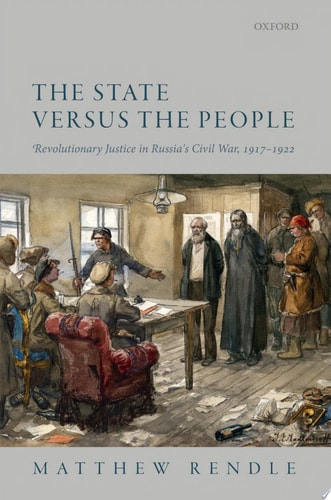
The State Versus The People: Revolutionary Justice In Russia's Civil War, 1917-1922
0
0
As an Amazon Associate and affiliate partner, Menrva Books earns from qualifying purchases. Learn more
Author Description
Cover -- The State Versus The People -- Copyright -- Contents -- List Of Figures -- List Of Abbreviations And Glossary -- Notes On The Text -- Acknowledgements -- Introduction -- Law And Revolution -- The Bolsheviks And The Law -- Revolutionary Justice Versus Revolutionary Violence -- The State Versus The People -- 1 Creating Revolutionary Justice -- The Decree On Courts -- The First Trials In Petrograd -- Press Tribunals -- The Formation Of Provincial Tribunals -- Defending Revolutionary Justice -- The Supreme Tribunal -- Streamlining Provincial Tribunals -- Attacking Revolutionary Terror 2 Extending State Authority -- Military Tribunals -- Transport Tribunals -- Travelling Sessions -- Unifying The Tribunal System -- Inspecting Tribunals -- From Revolutionary Consciousness To Revolutionary Legality -- The Persistence Of Exceptional Justice -- 3 Categorizing Counter-revolution -- The Emergence Of Counter-revolution -- The Expansion Of Counter-revolution -- Quantifying Counter-revolution -- Quantifying Counter-revolutionaries -- Mass Crimes And Shock Campaigns -- The Search For Stable Categories -- 4 The Trial -- The Pre-trial Process -- The Revolutionary Judge The Revolutionary Lawyer -- In Court -- Punishment And Revolutionary Consciousness -- Quantifying Punishment -- From 'model' Trial To 'show' Trial -- 5 The Logic Of Mercy -- The Nature Of Cassation -- A Dialogue On Justice -- The Prevalence Of Amnesties -- The Importance Of Amnesties -- Other Acts Of Mercy -- The Logic Of Mercy -- 6 Publicizing Revolutionary Justice -- The Educational Role Of Law -- The Language Of Justice -- Images Of Justice -- The Trial Of The Socialist Revolutionaries -- Conclusion -- Bibliography -- Archival Material -- Legal Periodicals -- Newspapers And Periodicals -- Film Contemporary Documents And Publications -- Memoirs, Diaries, And Letters -- Secondary Sources -- Index Matthew Rendle. Includes Bibliographical References And Index. Electronic Reproduction. Oxford Available Via World
Menrva's Summary
THE THESIS
This work investigates how the Bolshevik regime attempted to construct a functional legal system amidst the chaos of the Russian Civil War. Matthew Rendle, a historian specializing in early Soviet governance, examines the tension between the party's ideological commitment to revolutionary justice and the practical necessity of maintaining state control. By analyzing the evolution of revolutionary tribunals, the author argues that the Soviet legal apparatus was not merely an instrument of terror, but a complex mechanism designed to legitimize state authority and educate the populace in socialist consciousness.
THE SCOPE MAP
What You Will Find
- Analysis of the Decree on Courts and the formation of provincial tribunals
- Examination of the transition from revolutionary consciousness to revolutionary legality
- Investigation into the categorization of counter-revolutionary crimes
- Study of the role of amnesties and the logic of mercy in the Soviet judicial system
Scope Limits
- The study focuses primarily on the period between 1917 and 1922
- The text does not provide an exhaustive history of the Cheka or extra-judicial police operations
THE AUTHORITY PERSPECTIVE
Scholars in the field of Soviet history identify this text as a rigorous examination of the institutional development of early Bolshevik law. Readers frequently note the academic density of the prose and the extensive use of archival materials to challenge simplistic narratives of revolutionary violence.
Page Count:
336
Publication Date:
2020-01-01
Publisher:
Oxford University Press,
ISBN-10:
0192576852
ISBN-13:
9780192576859
History
Legal History
Russian History
Revolutionary Studies
European History
Administration of Justice
Community Tags
Similar Books