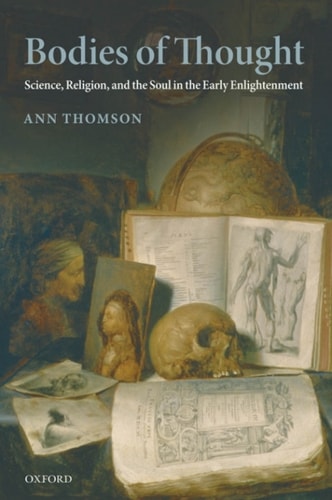
Bodies of Thought: Science, Religion, and the Soul in the Early Enlightenment
0
0
As an Amazon Associate and affiliate partner, Menrva Books earns from qualifying purchases. Learn more
Author Description
Examining the development of a secular, purely material conception of human beings in the early Enlightenment, Bodies of Thought provides a fresh perspective on the intellectual culture of this period, and challenges certain influential interpretations of irreligious thought and the 'Radical Enlightenment'. Beginning with the debate on the soul in England, in which political and religious concerns were intertwined, and ending with the eruption of materialism onto the public stage in mid-eighteenth-century France, Ann Thomson looks at attempts to explain how the material brain thinks without the need for an immaterial and immortal soul. She shows how this current of thinking fed into the later eighteenth-century 'Natural History of Man', the earlier roots of which have been overlooked by many scholars. Although much attention has been paid to the atheistic French materialists, their link to the preceding period has been studied only partially, and the current interest in what is called the 'Radical Enlightenment' has served to obscure rather than enlighten this history. By bringing out the importance of both Protestant theological debates and medical thinking in England, and by following the different debates on the soul in Holland and France, this book shows that attempts to find a single coherent strand of radical irreligious thought running through the early Enlightenment, coming to fruition in the second half of the eighteenth century, ignore the multiple channels which composed Enlightenment thinking.
Menrva's Summary
THE THESIS
This book investigates the historical development of materialist conceptions of the human soul and brain during the early Enlightenment, challenging the notion of a singular, coherent radical irreligious tradition. Ann Thomson, a scholar of intellectual history, utilizes a comparative analysis of theological and medical debates across England, Holland, and France to trace how thinkers attempted to explain human consciousness without recourse to an immaterial soul. By examining these diverse intellectual channels, she argues that the transition toward secular materialism was a complex, multifaceted process rather than a linear progression.
THE SCOPE MAP
What You Will Find
- Analysis of the debate on the soul in seventeenth-century England and its political implications.
- Examination of the intersection between Protestant theology and early medical theories of the brain.
- Comparative study of intellectual discourse in England, Holland, and France.
- Exploration of the roots of the eighteenth-century 'Natural History of Man'.
Scope Limits
- The book does not provide a comprehensive history of all Enlightenment atheism.
- It does not focus on the later, more popularized French materialist movements of the late eighteenth century.
THE AUTHORITY PERSPECTIVE
Scholars recognize this work as a significant contribution to the study of early modern intellectual history, particularly for its nuanced critique of the 'Radical Enlightenment' framework. Readers frequently note the academic density of the prose and the author's meticulous attention to the theological and medical origins of materialist thought.
Page Count:
320
Publication Date:
2008-01-01
Publisher:
OUP Oxford
ISBN-10:
0191553085
ISBN-13:
9780191553080
History
Religion
Science
Philosophy
Materialism
Intellectual History
Enlightenment
European History
Community Tags
Similar Books