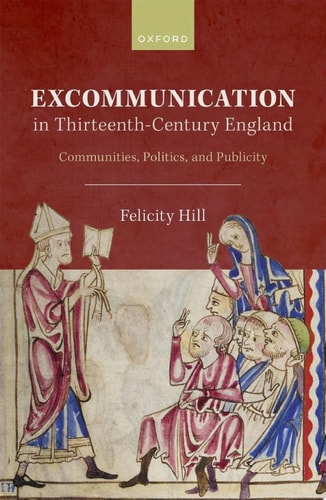
Excommunication in Thirteenth-Century England: Communities, Politics, and Publicity
0
0
As an Amazon Associate and affiliate partner, Menrva Books earns from qualifying purchases. Learn more
Author Description
Excommunication was the medieval churchs most severe sanction, used against people at all levels of society. It was a spiritual, social, and legal penalty. Excommunication in Thirteenth-Century England offers a fresh perspective on medieval excommunication by taking a multi-dimensional approach to discussion of the sanction. Using England as a case study, Felicity Hill analyzes the intentions behind excommunication; how it was perceived and received, at both national and local level; the effects it had upon individuals and society. The study is structured thematically to argue that our understanding of excommunication should be shaped by how it was received within the community as well as the intentions of canon law and clerics. Challenging past assumptions about the inefficacy of excommunication, Hill argues that the sanction remained a useful weapon for the clerical elite: bringing into dialogue a wide range of source material allows effectiveness to be judged within a broader context. The complexity of political communication and action are revealed through public, conflicting, accepted and rejected excommunications. Excommunication could be manipulated to great effect in political conflicts and was an important means by which political events were communicated down the social strata of medieval society. Through its exploration of excommunication, the book reveals much about medieval cursing, pastoral care, fears about the afterlife, social ostracism, shame and reputation, and mass communication.
Menrva's Summary
THE THESIS
This book investigates how excommunication functioned as a multifaceted instrument of social, legal, and political power within thirteenth-century English society. Felicity Hill, a specialist in medieval ecclesiastical history, utilizes a thematic framework to examine the gap between the formal intentions of canon law and the practical reception of the sanction by local communities. By synthesizing diverse primary sources, the author argues that excommunication was not merely a failed spiritual threat but a highly effective tool for political communication and social regulation.
THE SCOPE MAP
What You Will Find
- Analysis of the intersection between canon law and local social dynamics
- Examination of excommunication as a mechanism for political conflict and mass communication
- Investigation into the cultural impacts of shame, reputation, and fear of the afterlife
Scope Limits
- The study is geographically restricted to thirteenth-century England
- It does not provide a comprehensive history of excommunication across the entire medieval period or outside of the English context
THE AUTHORITY PERSPECTIVE
Scholars recognize this work as a significant contribution to the study of medieval ecclesiastical authority and social history. Readers frequently note the clarity with which Hill navigates complex legal and political source material to demonstrate the practical application of church sanctions.
Page Count:
354
Publication Date:
2022-01-01
Publisher:
OUP Oxford
ISBN-10:
0192576747
ISBN-13:
9780192576743
History
England
Legal History
European History
Sociology
Church History
Community Tags
Similar Books