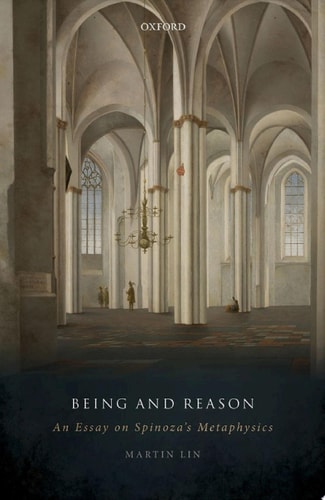
Being and Reason: An Essay on Spinoza's Metaphysics
0
0
As an Amazon Associate and affiliate partner, Menrva Books earns from qualifying purchases. Learn more
Author Description
In Being and Reason, Martin Lin offers a new interpretation of Spinoza's core metaphysical doctrines with attention to how and why, in Spinoza, metaphysical notions are entangled with cognitive, logical, and epistemic ones. For example, according to Spinoza, a substance is that which can be conceived through itself and a mode is that which is conceived through another. Thus, metaphysical notions, substance and mode, are defined through a notion that is either cognitive or logical, being conceived through. What are we to make of the intimate connections that Spinoza sees between metaphysical, cognitive, logical, and epistemic notions? Or between being and reason? Lin argues against idealist readings according to which the metaphysical is reducible to or grounded in something epistemic, logical, or psychological. He maintains that Spinoza sees the order of being and the order of reason as two independent structures that mirror one another. In the course of making this argument, he develops new interpretations of Spinoza's notions of attribute and mode, and of Spinoza's claim that all things strive for self-preservation. Lin also argues against prominent idealist readings of Spinoza according to which the Principle of Sufficient Reason is absolutely unrestricted for Spinoza and is the key to his system. He contends, rather, that Spinoza's metaphysical rationalism is a diverse phenomenon and that the Principle of Sufficient Reason is limited to claims about existence and nonexistence which are applied only once by Spinoza to the case of the necessary existence of God.
Menrva's Summary
THE THESIS
How does Spinoza reconcile the distinction between the order of being and the order of reason within his metaphysical framework? Martin Lin, a scholar specializing in early modern philosophy, examines the entanglement of metaphysical, cognitive, and logical concepts in Spinoza's work. He challenges traditional idealist interpretations by arguing that Spinoza posits two independent, mirroring structures for being and reason rather than reducing one to the other.
THE SCOPE MAP
What You Will Find
- Analysis of Spinoza's definitions of substance, attribute, and mode
- Re-evaluation of the Principle of Sufficient Reason in the context of existence
- Critique of idealist readings regarding the grounding of metaphysics in epistemic or psychological terms
Scope Limits
- Does not provide a general biography of Spinoza
- Does not cover the entirety of Spinoza's political or ethical writings beyond their metaphysical implications
THE AUTHORITY PERSPECTIVE
Scholars and students of early modern philosophy frequently note the technical rigor and analytical precision Lin brings to these complex metaphysical debates. Experts highlight this work as a significant contribution to the ongoing discourse surrounding Spinoza's rationalism and his specific application of the Principle of Sufficient Reason.
Page Count:
210
Publication Date:
2019-01-01
Publisher:
OUP Oxford
ISBN-10:
0192570900
ISBN-13:
9780192570901
Philosophy
Metaphysics
Philosophy history
Rationalism
Spinoza
Community Tags
Similar Books