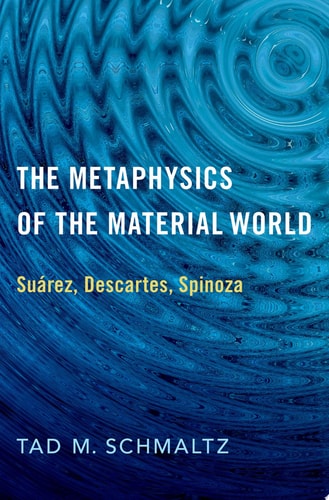
The Metaphysics of the Material World: Suárez, Descartes, Spinoza
0
0
As an Amazon Associate and affiliate partner, Menrva Books earns from qualifying purchases. Learn more
Author Description
In The Metaphysics of the Material World, Tad M. Schmaltz traces a particular development of the metaphysics of the material world in early modern thought. The route Schmaltz follows derives from a critique of Spinoza in the work of Pierre Bayle. Bayle charged in particular that Spinoza's monistic conception of the material world founders on the account of extension and its "modes" and parts that he inherited from Descartes, and that Descartes in turn inherited from late scholasticism, and ultimately from Aristotle. After an initial discussion of Bayle's critique of Spinoza and its relation to Aristotle's distinction between substance and accident, this study starts with the original re-conceptualization of Aristotle's metaphysics of the material world that we find in the work of the early modern scholastic Suárez. What receives particular attention is Suárez's introduction of the "modal distinction" and his distinctive account of the Aristotelian accident of "continuous quantity." This examination of Suárez is followed by a treatment of the connections of his particular version of the scholastic conception of the material world to the very different conception that Descartes offered. Especially important is Descartes's view of the relation of extended substance both to its modes and to the parts that compose it. Finally, there is a consideration of what these developments in Suárez and Descartes have to teach us about Spinoza's monistic conception of the material world. Of special concern here is to draw on this historical narrative to provide a re-assessment of Bayle's critique of Spinoza.
Menrva's Summary
THE THESIS
This study investigates the historical development of the metaphysics of the material world by tracing the conceptual lineage from late scholasticism through Descartes to Spinoza. Tad M. Schmaltz, a scholar of early modern philosophy, utilizes the critical framework provided by Pierre Bayle to evaluate the coherence of Spinozan monism. By analyzing the transition of concepts regarding extension, substance, and accidents, the author argues that Spinoza's system is deeply rooted in, and challenged by, the scholastic and Cartesian traditions that preceded it.
THE SCOPE MAP
What You Will Find
- Analysis of Francisco Suárez's re-conceptualization of Aristotelian metaphysics.
- Examination of the modal distinction and the accident of continuous quantity.
- Comparative study of Cartesian extended substance versus scholastic models.
- Re-assessment of Pierre Bayle's critique of Spinoza's monistic framework.
Scope Limits
- The text does not provide a comprehensive history of all early modern materialist theories.
- The analysis is restricted to the specific lineage of extension and substance as defined by the selected philosophers.
THE AUTHORITY PERSPECTIVE
Scholars in the field of early modern philosophy recognize this work as a rigorous examination of the technical underpinnings of seventeenth-century metaphysics. Readers frequently note the academic density of the prose, which requires a strong background in scholastic and Cartesian terminology to fully navigate.
Page Count:
312
Publication Date:
2019-12-04
Publisher:
Oxford University Press
ISBN-10:
0190070226
ISBN-13:
9780190070229
Philosophy
Politics
Medieval Thought
Social Philosophy
Early Modern
Humanism
Scholasticism
Renaissance
Good & Evil
Medieval
Metaphysics
New Used & Rental Textbooks
Philosophy history
Community Tags
Similar Books