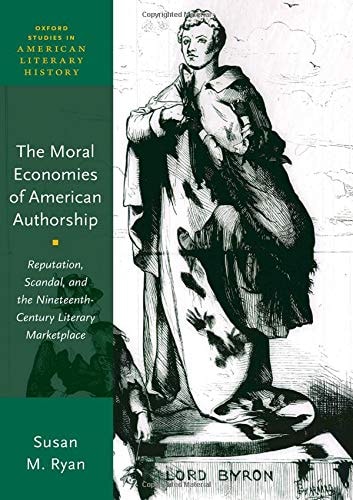
The Moral Economies of American Authorship: Reputation, Scandal, and the Nineteenth-Century Literary Marketplace
0
0
As an Amazon Associate and affiliate partner, Menrva Books earns from qualifying purchases. Learn more
Author Description
The Moral Economies of American Authorship argues that the moral character of authors became a kind of literary property within mid-nineteenth-century America's expanding print marketplace, shaping the construction, promotion, and reception of texts as well as of literary reputations. Using a wide range of printed materials--prefaces, dedications, and other paratexts as well as book reviews, advertisements, and editorials that appeared in the era's magazines and newspapers--The Moral Economies of American Authorship recovers and analyzes the circulation of authors' moral currency, attending not only to the marketing of apparently ironclad status but also to the period's not-infrequent author scandals and ensuing attempts at recuperation. These preoccupations prove to be more than a historical curiosity--they prefigure the complex (if often disavowed) interdependence of authorial character and literary value in contemporary scholarship and pedagogy. Combining broad investigations into the marketing and reception of books with case studies that analyze the construction and repair of particular authors' reputations (e.g., James Fenimore Cooper, Mary Prince, Elizabeth Keckley, Frederick Douglass, Harriet Beecher Stowe, and E.D.E.N. Southworth), the book constructs a genealogy of the field's investments in and uses of authorial character. In the nineteenth century's deployment of moral character as a signal element in the marketing, reception, and canonization of books and authors, we see how biography both vexed and created literary status, adumbrating our own preoccupations while demonstrating how malleable--and how recuperable--moral authority could be.
Menrva's Summary
THE THESIS
This book investigates how the moral character of nineteenth-century American authors functioned as a form of literary property that dictated the marketability and reception of their work. Susan M. Ryan, a scholar of American literature, utilizes a diverse array of archival materials—including prefaces, advertisements, and contemporary reviews—to demonstrate how authorial reputation was constructed, challenged by scandal, and strategically repaired. She argues that the nineteenth-century preoccupation with the moral standing of writers established a precedent for the modern interdependence of authorial identity and literary value.
THE SCOPE MAP
What You Will Find
- Analysis of nineteenth-century print culture including magazines, newspapers, and paratexts.
- Case studies of prominent figures such as James Fenimore Cooper, Frederick Douglass, and Harriet Beecher Stowe.
- Examination of the mechanisms behind authorial scandal and reputation management.
Scope Limits
- The study focuses primarily on the American literary marketplace and does not extend to international publishing trends of the same era.
- It does not provide a comprehensive biography of the authors mentioned, focusing instead on their public moral personas.
THE AUTHORITY PERSPECTIVE
Scholars in the field of American literary history identify this work as a significant contribution to the study of nineteenth-century print culture and the sociology of authorship. Readers frequently note the academic density of the prose and the depth of the archival research presented throughout the text.
Page Count:
232
Publication Date:
2019-07-01
Publisher:
Oxford University Press
ISBN-10:
0190067845
ISBN-13:
9780190067847
Publishing History
American History
Literary Criticism
Criticism history
New Used & Rental Textbooks
Literature
19th Century
Academic
Community Tags
Similar Books