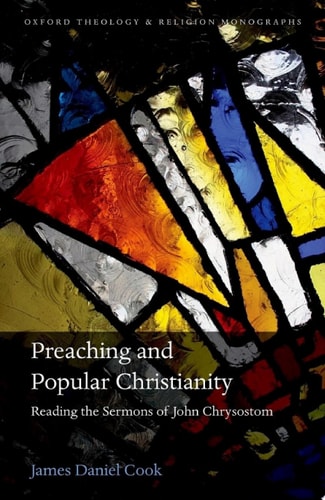
Preaching and Popular Christianity: Reading the Sermons of John Chrysostom
0
0
As an Amazon Associate and affiliate partner, Menrva Books earns from qualifying purchases. Learn more
Author Description
The vast homiletic corpus of John Chrysostom has received renewed attention in recent years as a source for the wider cultural and historical context within which his sermons were preached. Scholars have demonstrated the exciting potential his sermons have to shed light on aspects of daily life, popular attitudes, and practices of lay piety. In short, Chrysostom's sermons have been recognised as a valuable source for the study of 'popular Christianity' at the end of the fourth century. This study, however, questions the validity of some recent conclusions. James Daniel Cook illustrates that Chrysostom is often seen as at odds with the congregations to whom he preached. On this view, the Christianity of élites such as Chrysostom had made little inroads into popular thought beyond the fairly superficial, and congregations were still living with older, more culturally traditional views about religious beliefs which preachers were doing their utmost to overcome. Cook argues that such a portrayal is based on a misreading of Chrysostom's sermons and fails to explain satisfactorily the apparent popularity that Chrysostom enjoyed as a preacher. Preaching and Popular Christianity: Reading the Sermons of John Chrysostom reassesses how we read Chrysostom's sermons, with a particular focus on the stern language which permeated his preaching, and on which the image of the contrary congregation is largely based. In doing this, Cook recovers a neglected portrayal of Chrysostom as a pastor and of preaching as a pastoral and liturgical activity, and it becomes clear that his use of critical language says more about how he understood his role as preacher than about the nature of popular Christianity in late-antique society. Thus, a very different picture of late-antique Christianity emerges, in which Chrysostom's congregations are more willing to listen and learn from their preacher than is often assumed.
Menrva's Summary
THE THESIS
This study investigates whether the critical language found in the sermons of John Chrysostom accurately reflects a disconnect between the preacher and his congregation or if it serves a different pastoral function. James Daniel Cook, a scholar of late-antique theology, challenges the prevailing academic consensus that Chrysostom’s sermons reveal a fundamental divide between elite Christian doctrine and the traditional, popular beliefs of his audience. By re-examining the rhetorical strategies employed by Chrysostom, Cook argues that the preacher's stern tone was a deliberate pastoral tool rather than evidence of a resistant or uneducated laity.
THE SCOPE MAP
What You Will Find
- A critical analysis of the homiletic corpus of John Chrysostom.
- An examination of the rhetorical function of stern and critical language in late-antique preaching.
- A reassessment of the relationship between fourth-century preachers and their congregations.
Scope Limits
- The study focuses primarily on the rhetorical and pastoral intent of Chrysostom’s sermons rather than providing a comprehensive social history of all late-antique religious practices.
THE AUTHORITY PERSPECTIVE
Scholars and historians of late antiquity identify this work as a significant intervention in the study of patristic homiletics. The text is noted for its rigorous re-evaluation of how modern historians interpret the relationship between elite religious leaders and their audiences in the fourth century.
Page Count:
249
Publication Date:
2018-01-01
Publisher:
OUP Oxford
ISBN-10:
0192572962
ISBN-13:
9780192572967
History
Religion
Christianity
Late Antiquity
Theology
Preaching
Patristics
Community Tags
Other Editions(2)
Similar Books
Reader Comments
Share Your Thoughts
No comments yet. Be the first to share your thoughts!