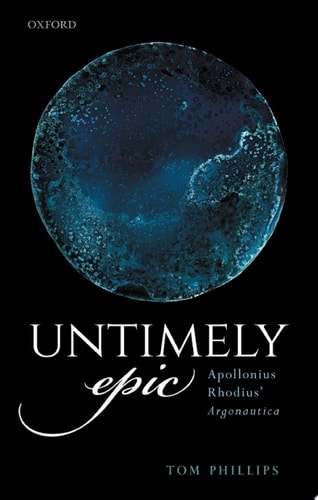
Untimely Epic: Apollonius Rhodius' Argonautica
0
0
As an Amazon Associate and affiliate partner, Menrva Books earns from qualifying purchases. Learn more
Author Description
Apollonius Rhodius' Argonautica is a voyage across time as well as space. The Argonauts encounter monsters, nymphs, shepherds, and kings who represent earlier stages of the cosmos or human society; they are given glimpses into the future, and themselves effect changes in the world through which they travel. Readers undergo a still more complex form of temporal transport, enabled not just to imagine themselves into the deep past, but to examine the layers of poetic and intellectual history from which Apollonius crafts his poem. Taking its lead from ancient critical preoccupations with poetry's ethical significance, this volume argues that the Argonautica produces an understanding of time and temporal experience which ramifies variously in readers' lives. When describing the people and creatures who occupied the past, Apollonius extends readers' capacity for empathetic response to the worlds inhabited by others. In the ecphrasis of Jason's cloak and the account of Jason's conversations with Medea, readers are invited to scrutinize the relationship between exempla and temporal change, while episodes such as the taking of the Golden Fleece explore links between perceptions and their temporal situation. Running through the poem, and through the readings that comprise this book, is an attention to the intellectual potential of the 'untimely' — objects, experience, and language which do not belong straightforwardly to a particular time. Treatment of such phenomena is crucial to the poem's aspiration to inform and expand readers' understanding of themselves as subjects in and of history.
Menrva's Summary
THE THESIS
This volume investigates how Apollonius Rhodius utilizes the concept of the 'untimely' to construct a complex understanding of temporal experience within the Argonautica. Tom Phillips, a scholar of classical literature, examines the poem not merely as a narrative of a voyage, but as a sophisticated intellectual framework that bridges the gap between the deep past and the reader's own historical subjectivity. By analyzing the poem's engagement with ethics and poetic history, the author argues that the text actively shapes how readers perceive their own place within the flow of time.
THE SCOPE MAP
What You Will Find
- Analysis of the Argonautica's temporal structures and narrative layers
- Examination of specific episodes including the ecphrasis of Jason's cloak and the interactions between Jason and Medea
- Discussion of ancient critical perspectives on the ethical significance of poetry
Scope Limits
- The text focuses primarily on the Argonautica and does not provide a comprehensive biography of Apollonius Rhodius
- It does not offer a general survey of Hellenistic literature beyond the scope of its specific temporal thesis
THE AUTHORITY PERSPECTIVE
Scholars and students of classical literature recognize this work as a nuanced contribution to the study of Hellenistic epic poetry. Readers frequently note the academic density of the prose, which is intended for those already familiar with the primary text and classical critical theory.
Page Count:
366
Publication Date:
2020-01-01
Publisher:
OUP Oxford
ISBN-10:
0192588192
ISBN-13:
9780192588197
Poetry
English
Philosophy of
Literary Criticism
English & College Success
Community Tags
Similar Books