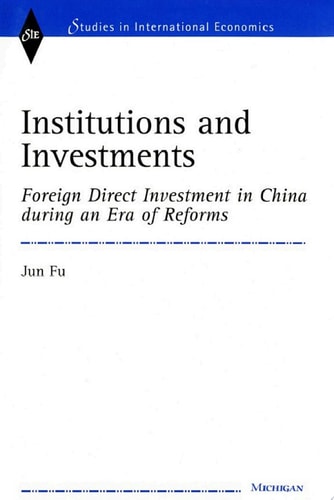
Institutions and Investments: Foreign Direct Investment in China during an Era of Reforms
0
0
As an Amazon Associate and affiliate partner, Menrva Books earns from qualifying purchases. Learn more
Author Description
As China continues to be heralded as a rising economic power, the need for an understanding of its institutional effects--such as investment-related policies, regulations, and laws--on foreign direct investment increases as well. Institutions and Investments employs interdisciplinary perspectives from economics, business, law, and political science to shed light on the interaction between institutional changes and investment patterns and to form a clear picture of investment behavior as China's legal and regulatory infrastructure has developed over the reform years. Organized into three main parts, the book first discusses the evolution and nature of China's FDI regulatory framework. Part 2 examines the various modes and variant patterns of FDI in China in the reform years. Part 3's central task is to demonstrate a systematic link between institutional changes in China's FDI regulatory framework and the changing patterns of FDI. In conclusion, Jun Fu finds that China has made substantial progress from a command economy to a market system, but that it still has a long way to go before it truly attains a transparent and rule-based system. This book adds new dimensions to the scholarship on China as a growing economic power and will be of particular interest to international economists, political scientists, and business scholars studying China. Jun Fu is Associate Professor in the School of Economics and Management, Tsinghua University.
Menrva's Summary
THE THESIS
This book investigates the intricate relationship between institutional reforms in China and the patterns of foreign direct investment (FDI) during its period of economic liberalization. Jun Fu, an Associate Professor at Tsinghua University, utilizes interdisciplinary perspectives from economics, business, law, and political science to analyze how China's evolving investment policies, regulations, and legal infrastructure have influenced FDI. The book is structured into three parts, examining the development of China's FDI regulatory framework, the modes and patterns of FDI, and the direct link between institutional changes and investment behavior. Ultimately, Fu concludes that while China has significantly transitioned from a command economy to a market system, it still requires further development towards a truly transparent and rule-based framework.
THE SCOPE MAP
- Evolution and nature of China's FDI regulatory framework.
- Various modes and variant patterns of FDI in China during the reform years.
- Systematic link between institutional changes and changing patterns of FDI.
- Analysis of China's progress from a command economy to a market system.
- Discussion on the development of China's legal and regulatory infrastructure.
- Interdisciplinary perspectives from economics, business, law, and political science.
THE AUTHORITY PERSPECTIVE
The book is of particular interest to international economists, political scientists, and business scholars studying China, offering new dimensions to the scholarship on China as a growing economic power. The analysis systematically demonstrates the link between institutional changes and FDI patterns, providing a clear picture of investment behavior as China's infrastructure developed. The work highlights substantial progress in China's economic transition while also pointing to areas needing further development towards a transparent, rule-based system. This comprehensive study offers valuable insights into the complexities of foreign direct investment within a reforming economy.
Page Count:
312
Publication Date:
2010-06-08
Publisher:
University of Michigan Press
ISBN-10:
0472026860
ISBN-13:
9780472026869
Non-Fiction
Economics
Business
Politics
Law
Community Tags
Other Editions(2)
Similar Books