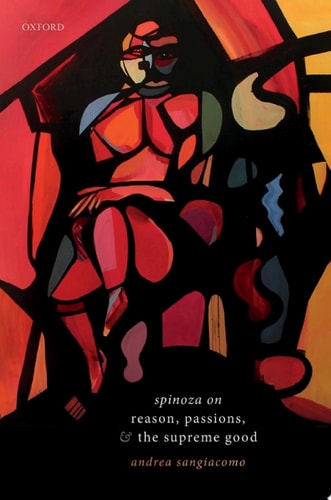
Spinoza on Reason, Passions, and the Supreme Good
0
0
As an Amazon Associate and affiliate partner, Menrva Books earns from qualifying purchases. Learn more
Author Description
Spinoza's thought is at the centre of an ever growing interest. Spinoza's moral philosophy, in particular, points to a radical way of understanding how human beings can become free and enjoy supreme happiness. And yet, there is still much disagreement about how exactly Spinoza's recipe is supposed to work. For long time, Spinoza has been presented as an arch rationalist who would identify in the purely intellectual cultivation of reason the key for ethical progress. Andrea Sangiacomo offers a new understanding of Spinoza's project, by showing how he himself struggled during his career to develop a moral philosophy that could speak to human beings as they actually are (imperfect, passionate, often not very rational). Spinoza's views significantly evolved over time. In his early writings, Spinoza's account of ethical progress towards the Supreme Good relies mostly on the idea that the mind can build on its innate knowledge to resist the power of the passions. Although appropriate social conditions may support the individual's pursuit of the Supreme Good, achieving it does not depend essentially on social factors. In Spinoza's later writings, however, the emphasis shifts towards the mind's need to rely on appropriate forms of social cooperation. Reason becomes the mental expression of the way the human body interacts with external causes on the basis of some degree of agreement in nature with them. The greater the agreement, the greater the power of reason to adequately understand universal features as well as more specific traits of the external causes. In the case of human beings, certain kinds of social cooperation are crucial for the development of reason. This view has crucial ramifications for Spinoza's account of how individuals can progress towards the Supreme Good and how a political science based on Spinoza's principles can contribute to this goal.
Menrva's Summary
THE THESIS
This book investigates how Baruch Spinoza’s moral philosophy evolved to address the practical challenges of human imperfection and the necessity of social cooperation in achieving the Supreme Good. Andrea Sangiacomo, a scholar of early modern philosophy, utilizes a chronological analysis of Spinoza’s corpus to challenge the traditional view of him as a rigid rationalist. The author argues that Spinoza’s project shifted from an early focus on individual intellectual resistance to passions toward a later, more nuanced emphasis on the role of social structures in fostering human reason.
THE SCOPE MAP
What You Will Find
- A chronological examination of Spinoza’s development from early to late writings.
- An analysis of the relationship between human passions and the cultivation of reason.
- A framework for understanding the intersection of individual ethics and political science.
Scope Limits
- The text does not provide a general biography of Spinoza’s life outside of his philosophical evolution.
- It does not offer a comprehensive critique of Spinoza’s metaphysics beyond its relevance to his moral and political theory.
THE AUTHORITY PERSPECTIVE
Scholars and students of early modern philosophy recognize this work as a significant contribution to the re-evaluation of Spinoza’s ethical project. Readers frequently note the academic density of the prose, which is intended for those already familiar with the core tenets of Spinozism.
Page Count:
256
Publication Date:
2019-01-01
Publisher:
OUP Oxford
ISBN-10:
0192587153
ISBN-13:
9780192587152
Philosophy
Ethics
Political Philosophy
Philosophy history
Rationalism
Community Tags
Other Editions(3)
Similar Books




Reader Comments
Share Your Thoughts
No comments yet. Be the first to share your thoughts!