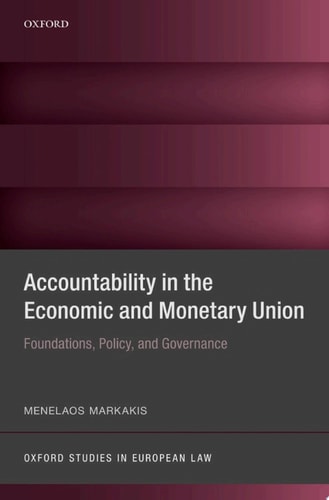
Accountability in the Economic and Monetary Union: Foundations, Policy, and Governance
0
0
As an Amazon Associate and affiliate partner, Menrva Books earns from qualifying purchases. Learn more
Author Description
Following the financial and public debt crisis, the EU's Economic and Monetary Union (EMU) has been under intense political scrutiny. The measures adopted in response to the crisis have granted additional powers to the EU (and national) authorities, the exercise of which can have massive implications for the economies of the Member States, financial institutions and, of course, citizens. The following questions arise: how can we hold accountable those institutions that are exercising power at the national and EU level? What is the appropriate level, type and degree of accountability and transparency that should be involved in the development of the EU's governance structures in the areas of fiscal and economic governance and the Banking Union? What is the role of parliaments and courts in holding those institutions accountable for the exercise of their duties? Is the revised EMU framework democratically legitimate? How can we bridge the gap between the citizens - and the institutions that represent them - and those institutions that are making these important decisions in the field of economic and monetary policy? This book principally examines the mechanisms for political and legal accountability in the EMU and the Banking Union. It examines the implications that the reforms of EU economic governance have had for the locus and strength of executive power in the Union, as well as the role of parliaments (and other political fora) and courts in holding the institutions acting in this area accountable for the exercise of their tasks. It further sets out several proposals regarding transparency, accountability, and legitimacy in the EMU.
Menrva's Summary
THE THESIS
This book investigates how the institutions governing the Economic and Monetary Union (EMU) and the Banking Union can be held accountable for their exercise of power following the post-crisis reforms. Menelaos Markakis, a legal scholar specializing in EU law, analyzes the shift in executive power within the Union and the subsequent democratic legitimacy concerns. By evaluating the roles of national parliaments, the European Parliament, and judicial bodies, the author provides a framework for assessing the transparency and accountability of fiscal and economic governance structures.
THE SCOPE MAP
What You Will Find
- Analysis of the post-crisis legal and political reforms in the EU.
- Examination of the balance of power between national and supranational authorities.
- Evaluation of the role of courts and parliaments in oversight mechanisms.
- Proposals for enhancing democratic legitimacy and transparency in economic policy.
Scope Limits
- The text focuses primarily on legal and political accountability mechanisms rather than purely macroeconomic performance data.
- It does not provide a comprehensive history of the Eurozone crisis beyond its impact on governance structures.
THE AUTHORITY PERSPECTIVE
Experts identify this work as a rigorous contribution to the study of European administrative and constitutional law. Readers frequently note the academic density of the prose, which makes it a specialized resource for legal scholars and policy practitioners interested in the institutional architecture of the EU.
Page Count:
406
Publication Date:
2020-01-01
Publisher:
OUP Oxford
ISBN-10:
0192583956
ISBN-13:
9780192583956
Economics
Public Policy
Law
European Union
Governance
Professional Career & Trade
Banking law
Community Tags
Similar Books