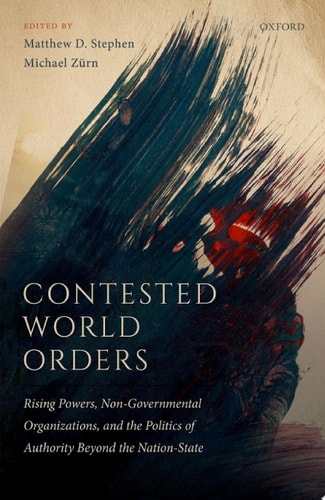
Contested World Orders: Rising Powers, Non-Governmental Organizations, and the Politics of Authority Beyond the Nation-State
0
0
As an Amazon Associate and affiliate partner, Menrva Books earns from qualifying purchases. Learn more
Author Description
World orders are increasingly contested. As international institutions have taken on ever more ambitious tasks, they have been challenged by rising powers dissatisfied with existing institutional inequalities, by non-governmental organizations worried about the direction of global governance, and even by some established powers no longer content to lead the institutions they themselves created. For the first time, this volume examines these sources of contestation under a common and systematic institutionalist framework. While the authority of institutions has deepened, at the same time it has fuelled contestation and resistance. In a series of rigorous and empirically revealing chapters, the authors of Contested World Orders examine systematically the demands of key actors in the contestation of international institutions. Ranging in scope from the World Trade Organization and the Nuclear Non-proliferation Regime to the Kimberley Process on conflict diamonds and the climate finance provisions of the UNFCCC, the chapters deploy a variety of methods to reveal just to what extent, and along which lines of conflict, rising powers and NGOs contest international institutions. Contested World Orders seeks answers to the key questions of our time: Exactly how deeply are international institutions contested? Which actors seek the most fundamental changes? Which aspects of international institutions have generated the most transnational conflicts? And what does this mean for the future of world order?
Menrva's Summary
THE THESIS
This volume investigates the mechanisms and drivers of contestation within international institutions as they face pressure from rising powers, non-governmental organizations, and established states. The authors, Matthew D. Stephen and Michael Zurn, utilize a systematic institutionalist framework to analyze how the deepening authority of global governance structures simultaneously generates resistance. By examining specific institutional domains, the text argues that the expansion of international mandates has created new fault lines of conflict that threaten the stability of the existing world order.
THE SCOPE MAP
What You Will Find
- A comparative analysis of international institutions including the WTO and the UNFCCC.
- A systematic framework for categorizing types of institutional contestation.
- Empirical case studies focusing on conflict diamonds and nuclear non-proliferation.
Scope Limits
- The analysis does not provide a comprehensive history of all international organizations.
- The text does not offer prescriptive policy solutions for resolving the identified conflicts.
THE AUTHORITY PERSPECTIVE
Experts recognize this work as a rigorous contribution to the study of international institutionalism and global power dynamics. Readers frequently note the academic density of the prose, making it most suitable for scholars and advanced students of political science.
Page Count:
407
Publication Date:
2019-01-01
Publisher:
OUP Oxford
ISBN-10:
0192580973
ISBN-13:
9780192580979
International relations
Power Social sciences
International business
Sociology
International Cooperation
Community Tags
Similar Books