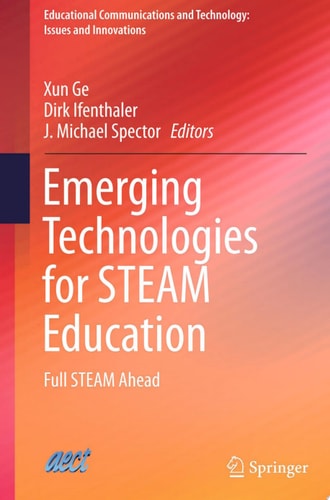
Emerging Technologies for STEAM Education
0
0
As an Amazon Associate and affiliate partner, Menrva Books earns from qualifying purchases. Learn more
Author Description
This theory-to-practice guide offers leading-edge ideas for wide-scale curriculum reform in sciences, technology, engineering, the arts, and mathematics--the STEAM subjects. Chapters emphasize the critical importance of current and emerging digital technologies in bringing STEM education up to speed and implementing changes to curricula at the classroom level. Of particular interest are the diverse ways of integrating the liberal arts into STEM course content in mutually reshaping humanities education and scientific education. This framework and its many instructive examples are geared to ensure that both educators and students can become innovative thinkers and effective problem-solvers in a knowledge-based society. Included in the coverage: Reconceptualizing a college science learning experience in the new digital era. Using mobile devices to support formal, informal, and semi-formal learning. Change of attitudes, self-concept, and team dynamics in engineering education. The language arts as foundational for science, technology, engineering, art, and mathematics. Can K-12 math teachers train students to make valid logical reasoning? Moving forward with STEAM education research. Emerging Technologies for STEAM Education equips educators, education researchers, administrators, and education policymakers with curricular and pedagogical strategies for making STEAM education the bedrock of accessible, relevant learning in keeping with today's digital advances.
Menrva's Summary
THE THESIS
This guide explores how emerging digital technologies can revolutionize STEAM education by integrating theory and practice for curriculum reform. The book addresses the critical need to update STEM education with current and emerging digital technologies, focusing on practical implementation at the classroom level. It highlights the integration of liberal arts into STEM to reshape both humanities and scientific education, aiming to foster innovative thinkers and problem-solvers for a knowledge-based society.
THE SCOPE MAP
- Reconceptualizing college science learning in the digital era.
- Utilizing mobile devices for formal, informal, and semi-formal learning.
- Examining changes in attitudes, self-concept, and team dynamics in engineering education.
- The foundational role of language arts in STEAM subjects.
- Investigating the capacity of K-12 math teachers to train students in logical reasoning.
- Strategies for advancing STEAM education research.
THE AUTHORITY PERSPECTIVE
This work is positioned as a theory-to-practice guide for educators, researchers, administrators, and policymakers seeking to implement modern digital technologies in STEAM curricula. The content suggests a focus on practical strategies and pedagogical approaches designed to make STEAM education relevant and accessible in the context of current digital advancements. The book aims to equip professionals with the tools needed to foster innovation and problem-solving skills in students.
Page Count:
411
Publication Date:
2015-09-09
Publisher:
Springer Nature
ISBN-10:
3319025732
ISBN-13:
9783319025735
Science & Technology
Non-Fiction
Technology
Steam
Education
Pedagogy
Community Tags
Similar Books