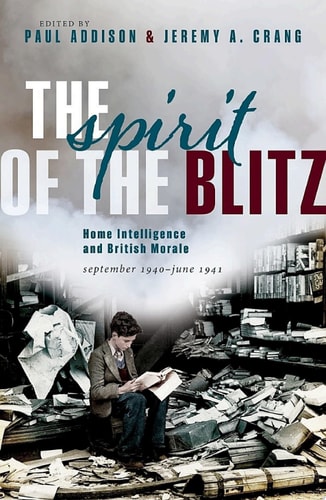
The Spirit of the Blitz: Home Intelligence and British Morale, September 1940 - June 1941
0
0
As an Amazon Associate and affiliate partner, Menrva Books earns from qualifying purchases. Learn more
Author Description
During the Blitz, the morale of the British people was clandestinely monitored by Home Intelligence, a unit of the Ministry of Information that kept watch on the behaviour and opinions of the public and eavesdropped on their conversations. Drawing on a wide range of intelligence sources from every region of the United Kingdom, a small team of officials based at the Senate House of the University of London compiled secret reports on the state of popular morale as the Luftwaffe attacked Britain's major towns and cities between September 1940 and May 1941. Edited and introduced by two leading historians of the period, who tell the inside story of Home Intelligence and why it proved so controversial in Whitehall, the complete and unabridged sequence of reports provide us with a unique and extraordinary window into the mindset of the British during a momentous period in their history. Not only do they include in-depth reports on the effects of the bombing, including special reports on Coventry, Clydebank, Hull, Barrow-in-Furness, Plymouth, Merseyside and Portsmouth, but also insights into almost every aspect of everyday life in Britain as well as the response of the public to the shifting military fortunes of the war. Reading like the collective diary of a nation, the reports strip away the nostalgia that has grown up around the period, reminding us instead of the sufferings and sacrifices, the many frustrations and difficulties of daily life, the administrative bungling, the grumbling and petty jealousies, and the determination of the overwhelming majority to put up with it all for the sake of beating Hitler.
Menrva's Summary
THE THESIS
This collection investigates the internal state of British public morale during the height of the Blitz by analyzing secret reports compiled by the Ministry of Information's Home Intelligence unit. Historians Jeremy A. Crang and Paul Addison curate these primary documents to examine how the government monitored civilian behavior, public opinion, and private conversations between September 1940 and June 1941. The authors provide the necessary administrative context to explain why these surveillance efforts were viewed as controversial within Whitehall at the time.
THE SCOPE MAP
What You Will Find
- A complete, unabridged sequence of secret Home Intelligence reports from the Blitz era.
- Detailed regional analysis of bombing impacts on cities including Coventry, Hull, and Portsmouth.
- Documentation of civilian responses to military developments and daily wartime hardships.
Scope Limits
- The text is restricted to the specific timeframe of September 1940 through June 1941.
- It does not provide a comprehensive military history of the Luftwaffe's tactical operations.
THE AUTHORITY PERSPECTIVE
Historians and researchers frequently cite this volume as a critical primary source for understanding the social realities of the British home front. Experts highlight the text for its ability to strip away post-war nostalgia and provide an unfiltered look at the administrative and civilian challenges of the period.
Page Count:
537
Publication Date:
2020-01-01
Publisher:
OUP Oxford
ISBN-10:
0192588060
ISBN-13:
9780192588067
History
World War
British History
Military History
Primary Sources
Social History
Community Tags
Similar Books