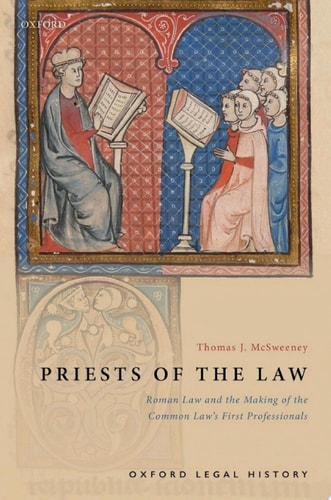
Priests of the Law: Roman Law and the Making of the Common Law's First Professionals
0
0
As an Amazon Associate and affiliate partner, Menrva Books earns from qualifying purchases. Learn more
Author Description
Priests of the Law tells the story of the first people in the history of the common law to think of themselves as legal professionals. In the middle decades of the thirteenth century, a group of justices working in the English royal courts spent a great deal of time thinking and writing about what it meant to be a person who worked in the law courts. This book examines the justices who wrote the treatise known as Bracton. Written and re-written between the 1220s and the 1260s, Bracton is considered one of the great treatises of the early common law and is still occasionally cited by judges and lawyers when they want to make the case that a particular rule goes back to the beginning of the common law. This book looks to Bracton less for what it can tell us about the law of the thirteenth century, however, than for what it can tell us about the judges who wrote it. The judges who wrote Bracton - Martin of Pattishall, William of Raleigh, and Henry of Bratton - were some of the first people to work full-time in England's royal courts, at a time when there was no recourse to an obvious model for the legal professional. They found one in an unexpected place: they sought to clothe themselves in the authority and prestige of the scholarly Roman-law tradition that was sweeping across Europe in the thirteenth century, modelling themselves on the jurists of Roman law who were teaching in European universities. In Bracton and other texts they produced, the justices of the royal courts worked hard to ensure that the nascent common-law tradition grew from Roman Law. Through their writing, this small group of people, working in the courts of an island realm, imagined themselves to be part of a broader European legal culture. They made the case that they were not merely servants of the king: they were priests of the law.
Menrva's Summary
THE THESIS
This book investigates how thirteenth-century English royal justices established a professional identity by integrating Roman legal traditions into the nascent common law. Thomas J. McSweeney, a legal historian, utilizes the treatise known as Bracton to analyze the intellectual development of early English judges. He argues that these jurists, specifically Martin of Pattishall, William of Raleigh, and Henry of Bratton, consciously modeled their professional status on the scholarly Roman-law tradition to elevate their authority beyond mere royal service.
THE SCOPE MAP
What You Will Find
- Analysis of the thirteenth-century treatise Bracton as a window into judicial self-conception.
- Examination of the influence of European university-based Roman law on English royal courts.
- Biographical focus on the first full-time legal professionals in the English court system.
Scope Limits
- The text does not provide a comprehensive history of the entire common law system.
- It does not focus on the practical application of thirteenth-century law in local or manorial courts.
THE AUTHORITY PERSPECTIVE
Legal historians recognize this work as a significant contribution to understanding the intellectual origins of the English legal profession. Scholars frequently note the author's ability to bridge the gap between continental Roman law and the development of the English common law tradition.
Page Count:
294
Publication Date:
2019-01-01
Publisher:
OUP Oxford
ISBN-10:
0192584197
ISBN-13:
9780192584199
History
Professional Career & Trade
English History
Law
Great Britain
Legal History
Roman law
Community Tags
Similar Books