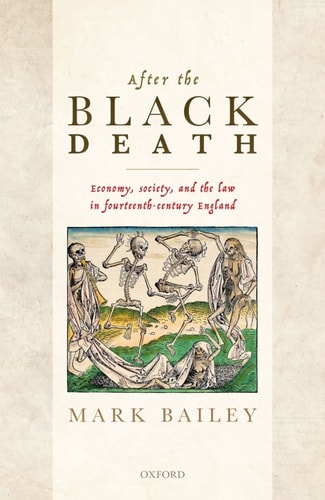
After the Black Death: Economy, Society, and the Law in Fourteenth-Century England
0
0
As an Amazon Associate and affiliate partner, Menrva Books earns from qualifying purchases. Learn more
Author Description
The Black Death of 1348-9 is the most catastrophic event and worst pandemic in recorded history. After the Black Death offers a major reinterpretation of its immediate impact and longer-term consequences in England. After the Black Death reassesses the established scholarship on the impact of plague on fourteenth-century England and draws upon original research into primary sources to offer a major re-interpretation of the subject. It studies how the government reacted to the crisis, and how communities adapted in its wake. It places the pandemic within the wider context of extreme weather and epidemiological events, the institutional framework of markets and serfdom, and the role of law in reducing risks and conditioning behaviour. The government's response to the Black Death is reconsidered in order to cast new light on the Peasants' Revolt of 1381. By 1400, the effects of plague had resulted in major changes to the structure of society and the economy, creating the pre-conditions for England's role in the Little Divergence (whereby economic performance in parts of north western Europe began to move decisively ahead of the rest of the continent). After the Black Death explores in detail how a major pandemic transformed society, and, in doing so, elevates the third quarter of the fourteenth century from a little-understood paradox to a critical period of profound and irreversible change in English and global history.
Menrva's Summary
THE THESIS
This work investigates how the Black Death acted as a catalyst for profound economic, social, and legal transformations in fourteenth-century England. Mark Bailey, a specialist in medieval economic history, utilizes extensive primary source research to challenge existing scholarship regarding the pandemic's immediate and long-term consequences. By analyzing the interplay between institutional frameworks, environmental factors, and government policy, the author argues that the plague created the necessary conditions for England's subsequent economic divergence from the rest of the continent.
THE SCOPE MAP
What You Will Find
- Analysis of the institutional framework of markets and serfdom in post-plague England.
- Examination of government legislative responses to the crisis and their link to the Peasants' Revolt of 1381.
- Integration of epidemiological data with historical records of extreme weather events.
- Exploration of the role of law in risk mitigation and behavioral conditioning.
Scope Limits
- The study is geographically confined to England rather than providing a comprehensive pan-European analysis.
- The focus remains primarily on economic and institutional structures rather than personal or biographical accounts of the era.
THE AUTHORITY PERSPECTIVE
Scholars and historians recognize this text as a significant re-evaluation of the late medieval period, noting its rigorous use of primary source material. Readers frequently highlight the author's ability to synthesize complex economic data into a coherent narrative regarding the structural evolution of English society.
Page Count:
392
Publication Date:
2021-01-01
Publisher:
OUP Oxford
ISBN-10:
0192599747
ISBN-13:
9780192599742
History
England
Social History
Great Britain
Economic History
European History
Legal History
Community Tags
Similar Books