Depicting Orthodoxy in the Russian Middle Ages: The Novgorod Icon of Sophia, the Divine Wisdom
0
0
As an Amazon Associate and affiliate partner, Menrva Books earns from qualifying purchases. Learn more
Author Description
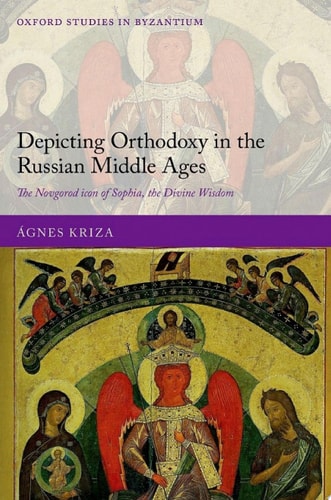
The image of Divine Wisdom, traditionally associated with the Sophia Cathedral in Novgorod, is an innovation of the fifteenth century. The icon represents the winged, royal, red-faced Sophia flanked by the Mother of God and John the Baptist. Although the image has a contemporaneous commentary, and although it exercised a profound influence on Russian cultural history, its meaning, together with the dating and localisation of the first appearance of the iconography, has remained an art-historical conundrum. By exploring the message, roots, function, and historical context of the creation of the first, most emblematic and enigmatic Russian allegorical iconography, Depicting Orthodoxy in the Russian Middle Ages deciphers the meaning of this icon. In contrast to previous interpretations, Kriza argues that the winged Sophia is the personification of the Orthodox Church. The Novgorod Wisdom icon represents the Church of Hagia Sophia, that is, Orthodoxy, as it was perceived in fifteenth-century Rus. Depicting Orthodoxy asserts that the icon, together with its commentary, was a visual-textual response to the Union of Florence between the Catholic and Orthodox Churches, signed in 1439 but rejected by the Russians in 1441. This interpretation is based on detailed interdisciplinary research, drawing on philology, art history, theology, and history. Kriza's study challenges some key assumptions concerning the relevance of Church Schism of 1054, the polemics between the Greeks and the Latins about the bread of Eucharist, and the role of the Union of Florence in the history of Russian art. In particular, by studying both well- and lesser-known works of art alongside overlooked textual evidence, this volume investigates how the Christian Church and its true faith were defined and visualized in Rus and Byzantium throughout the centuries.
Menrva's Summary
THE THESIS
This study investigates the origins, iconography, and theological significance of the Novgorod icon of Sophia, the Divine Wisdom, to determine its role as a visual representation of the Orthodox Church in fifteenth-century Russia. Ágnes Kriza, an expert in Byzantine and Russian art history, synthesizes philological, theological, and historical evidence to challenge established narratives regarding the icon's meaning. She argues that the image serves as a specific polemical response to the Union of Florence, positioning the winged Sophia as a personification of the Orthodox Church rather than a purely mystical figure.
THE SCOPE MAP
What You Will Find
- Detailed analysis of the Novgorod Sophia icon's visual components and its associated contemporary commentary.
- An interdisciplinary framework combining art history, theology, and philology to interpret medieval Russian religious artifacts.
- Examination of the political and religious tensions between the Catholic and Orthodox Churches following the Union of Florence.
Scope Limits
- The study focuses primarily on the fifteenth-century Novgorod icon and its immediate historical context, rather than providing a comprehensive survey of all Sophia iconography throughout history.
THE AUTHORITY PERSPECTIVE
Scholars recognize this work as a rigorous contribution to the study of Russian medieval art and its intersection with political theology. Readers frequently note the academic density of the prose and the depth of the primary source research provided by the author.
Page Count:
384
Publication Date:
2022-01-01
Publisher:
OUP Oxford
ISBN-10:
0192596276
ISBN-13:
9780192596277
History
Art History
Wisdom Literature
Theology
Russian History
Iconography
Community Tags
Similar Books