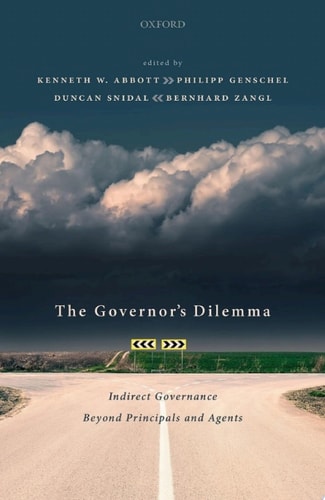
The Governor's Dilemma: Indirect Governance Beyond Principals and Agents
0
0
As an Amazon Associate and affiliate partner, Menrva Books earns from qualifying purchases. Learn more
Author Description
The Governor's Dilemma develops a general theory of indirect governance based on the tradeoff between governor control and intermediary competence; the empirical chapters apply that theory to a diverse range of cases encompassing both international relations and comparative politics. The theoretical framework paper starts from the observation that virtually all governance is indirect, carried out through intermediaries. But governors in indirect governance relationships face a dilemma: competent intermediaries gain power from the competencies they contribute, making them difficult to control, while efforts to control intermediary behavor limit important intermediary competencies, including expertise, credibility, and legitimacy. Thus, governors can obtain either high intermediary competence or strong control, but not both. This competence-control tradeoff is a common condition of indirect governance, whether governors are domestic or international, public or private, democratic or authoritarian; and whether governance addresses economic, security, or social issues. The empirical chapters analyze the operation and implications of the governor's dilemma in cases involving the governance of violence (e.g., secret police, support for foreign rebel groups, private security companies), the governance of markets (e.g., the Euro crisis, capital markets, EU regulation, the G20), and cross-cutting governance issues (colonial empires, "Trump's Dilemma"). Competence-control theory helps explain many features of governance that other theories cannot: why indirect governance is not limited to principal-agent delegation, but takes multiple forms; why governors create seemingly counter-productive intermediary relationships; and why indirect governance is frequently unstable over time.
Menrva's Summary
THE THESIS
The book investigates the fundamental tension between governor control and intermediary competence in indirect governance structures. The authors, Bernhard Zangl, Duncan Snidal, and Kenneth W. Abbott, utilize a comparative theoretical framework to argue that governors face an unavoidable tradeoff: increasing control over an intermediary inevitably diminishes the specialized competencies—such as expertise, credibility, and legitimacy—that the intermediary provides. By analyzing diverse political and economic systems, the authors demonstrate that this dilemma persists across domestic, international, public, and private governance domains.
THE SCOPE MAP
What You Will Find
- A comprehensive competence-control theoretical framework for analyzing indirect governance.
- Comparative analysis of governance in the realms of violence, market regulation, and historical colonial structures.
- Application of the theory to contemporary issues including the Euro crisis, G20 operations, and private security firms.
Scope Limits
- The text does not provide prescriptive policy solutions for resolving the dilemma, focusing instead on descriptive and explanatory analysis.
- It does not cover every possible form of direct governance, as the scope is strictly limited to indirect relationships.
THE AUTHORITY PERSPECTIVE
Scholars in political science and international relations identify this work as a significant contribution to the study of delegation and institutional design. Readers frequently note the academic density of the prose, which is intended for researchers and advanced students of political institutions.
Page Count:
320
Publication Date:
2020-01-01
Publisher:
OUP Oxford
ISBN-10:
0192597248
ISBN-13:
9780192597243
Comparative Politics
International relations
Governance
Public Policy
Community Tags
Similar Books