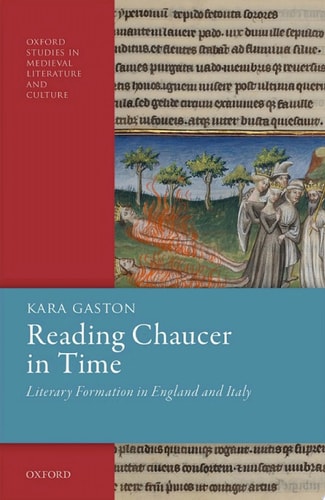
Reading Chaucer in Time: Literary Formation in England and Italy
0
0
As an Amazon Associate and affiliate partner, Menrva Books earns from qualifying purchases. Learn more
Author Description
The monograph series Oxford Studies in Medieval Literature and Culture showcases the plurilingual and multicultural quality of medieval literature and actively seeks to promote research that not only focuses on the array of subjects medievalists now pursue in literature, theology, and philosophy, in social, political, jurisprudential, and intellectual history, the history of art, and the history of science but also that combines these subjects productively. It offers innovative studies on topics that may include, but are not limited to, manuscript and book history; languages and literatures of the global Middle Ages; race and the post-colonial; the digital humanities, media and performance; music; medicine; the history of affect and the emotions; the literature and practices of devotion; the theory and history of gender and sexuality, ecocriticism and the environment; theories of aesthetics; medievalism. Reading for form can mean reading for formation. Understanding processes through which a text was created can help us in characterizing its form. But what is involved in bringing a diachronic process to bear upon a synchronic work? When does literary formation begin and end? When does form happen? These questions emerge with urgency in the interactions between English poet Geoffrey Chaucer and Italian trecento authors Dante Alighieri, Giovanni Boccaccio, and Francis Petrarch. In fourteenth-century Italy, new ways were emerging of configuring the relation between author and reader. Previously, medieval reading was often oriented around the significance of the text to the individual reader. In Italy, however, reading was beginning to be understood as a way of getting back to a work's initial formation. This book tracks how concepts of reading developed within Italian texts, including Dante's Vita nova, Boccaccio's Filostrato and Teseida, and Petrarch's Seniles, impress themselves upon Chaucer's Troilus and Criseyde and Canterbury Tales. It argues that Chaucer's poetry
Menrva's Summary
THE THESIS
This book investigates how the diachronic process of literary formation in fourteenth-century Italian texts influenced the synchronic poetic structures of Geoffrey Chaucer. Kara Gaston, a scholar of medieval literature, utilizes a comparative framework to analyze the intersection of Italian trecento authors—Dante, Boccaccio, and Petrarch—with Chaucer’s major works. The study argues that the shift in Italian reading practices, which emphasized the author's initial creative process, fundamentally shaped Chaucer’s approach to his own literary output.
THE SCOPE MAP
What You Will Find
- Comparative analysis of Dante’s Vita nova, Boccaccio’s Filostrato and Teseida, and Petrarch’s Seniles.
- Examination of Chaucer’s Troilus and Criseyde and The Canterbury Tales.
- Theoretical exploration of the relationship between diachronic formation and synchronic form.
Scope Limits
- The study does not provide a comprehensive biography of Chaucer or the Italian authors mentioned.
- It does not cover the entirety of medieval European literature outside of the specific English-Italian literary exchange.
THE AUTHORITY PERSPECTIVE
Scholars in the field of medieval studies recognize this work as a significant contribution to the understanding of cross-cultural literary influence in the fourteenth century. Readers frequently note the academic density of the prose, which is intended for an audience familiar with medieval literary theory and philology.
Page Count:
214
Publication Date:
2020-01-01
Publisher:
OUP Oxford
ISBN-10:
019259432X
ISBN-13:
9780192594327
Literature History
Chaucer
Comparative
English
English literature
English & College Success
Italian
Literary Criticism
Community Tags
Similar Books