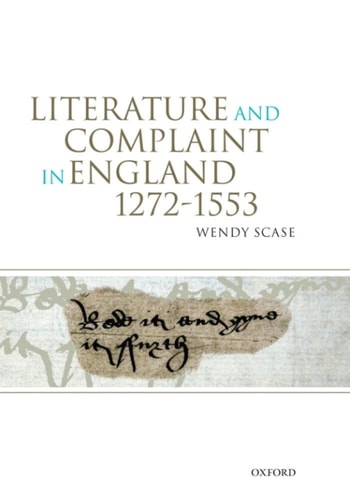
Literature and Complaint in England 1272-1553
0
0
As an Amazon Associate and affiliate partner, Menrva Books earns from qualifying purchases. Learn more
Author Description
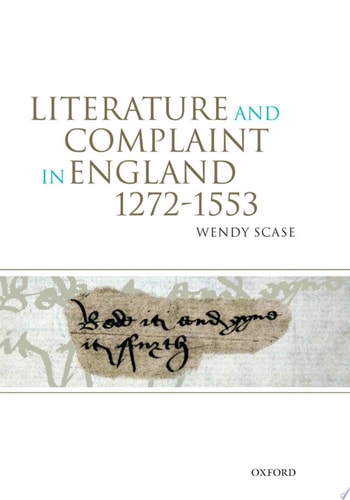
Literature and Complaint in England 1272-1553 gives an entirely new and original perspective on the relations between early judicial process and the development of literature in England. Wendy Scase argues that texts ranging from political libels and pamphlets to laments of the unrequited lover constitute a literature shaped by the new and crucial role of complaint in the law courts. She describes how complaint took on central importance in the development of institutions such as Parliament and the common law in later medieval England, and argues that these developments shaped a literature of complaint within and beyond the judicial process. She traces the story of the literature of complaint from the earliest written bills and their links with early complaint poems in English, French, and Latin, through writings associated with political crises of the fourteenth and fifteenth centuries, to the libels and petitionary pamphlets of Reformation England. A final chapter, which includes analyses of works by Chaucer, Hoccleve, and related writers, proposes far-reaching revisions to current histories of the arts of composition in medieval England. Throughout, close attention is paid to the forms and language of complaint writing and to the emergence of an infrastructure for the production of plaint texts, and many images of plaints and petitions are included. The texts discussed include works by well-known authors as well as little-known libels and pamphlets from across the period.
Menrva's Summary
THE THESIS
How did the evolution of judicial complaint procedures in medieval and early modern England fundamentally shape the development of its literature? Wendy Scase, a scholar of medieval literature, utilizes a multidisciplinary approach to bridge the gap between legal history and literary production. She argues that the institutionalization of the 'complaint' within the common law and Parliament provided a structural and linguistic model that permeated diverse texts, from political libels to courtly love poetry.
THE SCOPE MAP
What You Will Find
- Analysis of the transition from oral to written legal petitions and bills.
- Examination of political libels, pamphlets, and petitionary literature from 1272 to 1553.
- Comparative study of complaint forms across English, French, and Latin texts.
- Case studies of literary works by Chaucer, Hoccleve, and anonymous pamphleteers.
Scope Limits
- The study focuses primarily on the intersection of legal and literary complaint rather than a comprehensive history of all English literature during this period.
- It does not provide an exhaustive survey of every legal document produced, focusing instead on those with clear literary parallels.
THE AUTHORITY PERSPECTIVE
Scholars recognize this work as a significant contribution to the study of medieval literary history, particularly for its integration of legal records with canonical and non-canonical texts. Readers frequently note the academic density of the prose, which is intended for specialists in medieval studies and legal history.
Page Count:
230
Publication Date:
2007-01-01
Publisher:
Oxford University Press
ISBN-10:
0191533785
ISBN-13:
9780191533785
History
English literature
English
Legal History
Cultural History
English & College Success
Literary Criticism