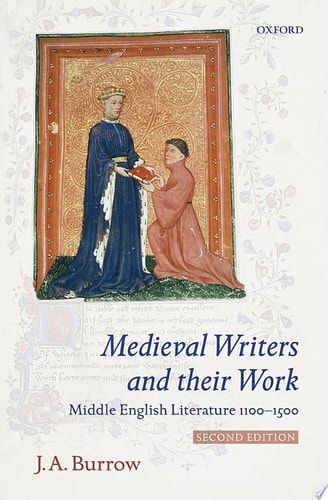
Medieval Writers and their Work: Middle English Literature 1100-1500
0
0
As an Amazon Associate and affiliate partner, Menrva Books earns from qualifying purchases. Learn more
Author Description
In an updated edition of his hugely successful student introduction to English literature from 1100 to 1500, J. A. Burrow takes account of scholarly developments in the the field, most notably devoting a final chapter to the impact of historicism on medieval studies. Full of information and stimulating ideas, and a pleasure to read, Burrow's book deals with circumstances of composition and reception, the main genres, 'modes of meaning' (allegory etc.), and medieval literature's afterlife in modern times. It shows that the literature of authors such as Chaucer, Gower, and Langland is more readily accessible than usually imagined, and well worth reading too. By placing medieval writers in their historical context - the four centuries between the Norman Conquest and the Renaissance - Professor Burrow explains not only how they wrote, but why.
Menrva's Summary
THE THESIS
How did the social, political, and cultural circumstances of the Middle Ages shape the production and reception of Middle English literature between 1100 and 1500? J. A. Burrow, a distinguished scholar of medieval literature, utilizes his extensive academic background to provide a structured overview of the period. He argues that by situating authors like Chaucer, Gower, and Langland within their specific historical contexts, modern readers can bridge the gap between contemporary perspectives and medieval modes of thought. The text synthesizes historical data with literary analysis to explain the motivations and methodologies of writers during the four centuries following the Norman Conquest.
THE SCOPE MAP
What You Will Find
- Analysis of the transition from oral tradition to written manuscript culture.
- Examination of primary literary genres including allegory, romance, and religious verse.
- Discussion of the impact of historicism on modern medieval studies.
- Contextualization of major authors such as Geoffrey Chaucer, John Gower, and William Langland.
Scope Limits
- The text focuses primarily on Middle English literature and does not provide an exhaustive survey of Latin or Anglo-Norman texts from the same period.
- It does not serve as a comprehensive anthology of primary source texts but rather as a critical guide to their interpretation.
THE AUTHORITY PERSPECTIVE
Scholars and students frequently cite this work as a foundational, accessible introduction to the complexities of medieval literary history. Experts highlight the clarity of Burrow's prose, noting that it successfully balances academic rigor with an approachable style for those new to the field.
Page Count:
164
Publication Date:
2008-01-01
Publisher:
OUP Oxford
ISBN-10:
0191037354
ISBN-13:
9780191037351
English literature
Academic
Literature History
English & College Success
Literary Criticism
English