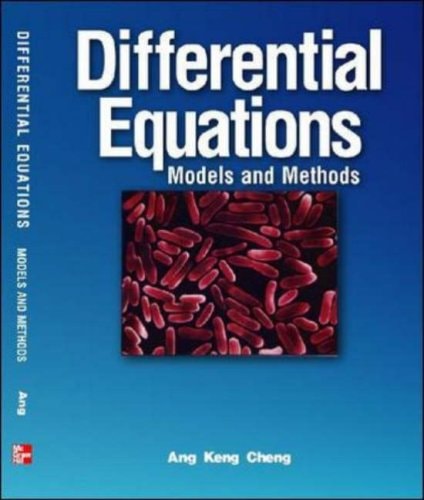
Differential Equations: Models and Methods
0
0
As an Amazon Associate and affiliate partner, Menrva Books earns from qualifying purchases. Learn more
Author Description
Many books on differential equations assume that the reader has a fairly sophisticated level of competence in calculus at the university level. Differential Equations: Models and Methods differs from them in that it enables a student with some basic knowledge of calculus to learn about differential equations and appreciate their applications. The focus of the book is on first order differential equations, their methods of solution and their use in mathematical models. Methods include analytic and graphical solutions, as well as numerical techniques. Readers will not only learn the necessary techniques of solving first order differential equations, but also how these equations can be applied in different fields. Examples have been carefully chosen to provide motivation for new concepts or techniques, and to illustrate the importance of differential equations. This book was written with student needs in mind; in particular, pre-university students taking the new GCE 'A' Level H3 Mathematics will find it useful in helping them through the course.
Menrva's Summary
THE THESIS
This book introduces the fundamental concepts and methods of first-order differential equations, emphasizing their application in mathematical modeling. The author, Keng Cheng Ang, aims to make differential equations accessible to students with a basic calculus background, differing from texts that assume advanced university-level calculus proficiency. The book concentrates on first-order equations, detailing analytic, graphical, and numerical solution techniques, and demonstrating their utility across various fields through carefully selected examples designed to motivate new concepts and illustrate the importance of differential equations.
THE SCOPE MAP
- Focus on first-order differential equations
- Methods of solution: analytic, graphical, and numerical techniques
- Applications in mathematical modeling across different fields
- Examples chosen to motivate concepts and illustrate importance
- Suitable for students with basic calculus knowledge
- Specifically useful for pre-university students taking GCE 'A' Level H3 Mathematics
THE AUTHORITY PERSPECTIVE
The book is positioned as a resource for students with a foundational understanding of calculus, aiming to demystify differential equations and their practical applications. Its focus on first-order equations and diverse solution methods, including numerical techniques, suggests a curriculum-oriented approach. The inclusion of examples intended to motivate and illustrate the relevance of the subject matter indicates a pedagogical design tailored for student comprehension, particularly for those preparing for advanced mathematics examinations.
Page Count:
215
Publication Date:
2006-05-01
Publisher:
McGraw-Hill
ISBN-10:
0071250859
ISBN-13:
9780071250856
Science
Non-Fiction
Calculus
Mathematical Modeling
Mathematics
Community Tags
Similar Books