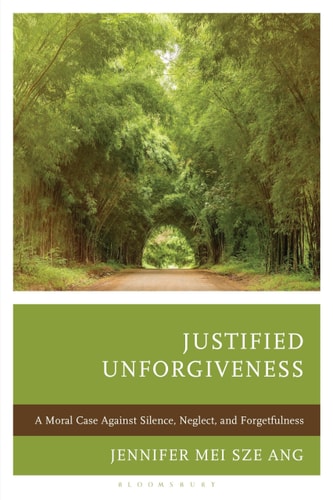
Justified Unforgiveness: A Moral Case Against Silence, Neglect, and Forgetfulness
0
0
As an Amazon Associate and affiliate partner, Menrva Books earns from qualifying purchases. Learn more
Author Description
Justified Unforgiveness: A Moral Case Against Silence, Neglect, and Forgetfulness corrects the overemphasis on the benefits of forgiveness and shows how unforgiveness is a morally appropriate – and at times morally necessary – response towards unremorseful and unrepentant wrongdoers, grave wrongs brought about by absolute evil, and situations where justice is not served. In advancing an argument for unforgiveness, Jennifer M.S. Ang deals with three dimensions of forgiveness – forgiveness as the letting go of resentment, forgiveness as reparation of damaged moral relations with the community, and forgiveness as letting the past remain in the past. Ang examines these arguments using cases of mass atrocities that are not often discussed in the forgiveness literature, such as the Nanking massacre, the Japanese military comfort women system, and the Khmer Rouge genocide, to reflect on the paradigm example of the Holocaust as absolute evil. These discussions also clarify the relationship between time, forgiveness, and justice– how time can affect the willingness to forgive; how the carrying out of justice over time remains vulnerable to politicization; and how memory of mass atrocities enables victims to let go without forgiving.
Menrva's Summary
THE THESIS
This book argues that unforgiveness can be a morally appropriate response to grave wrongs when justice is not served. Jennifer M.S. Ang challenges the prevailing emphasis on forgiveness by presenting a case for unforgiveness as a necessary moral stance against unremorseful wrongdoers and perpetrators of absolute evil. The book explores three facets of forgiveness: the release of resentment, the restoration of moral relationships, and the acceptance of the past. Ang critically examines these concepts through the lens of historical atrocities, including the Nanking massacre, the Japanese military comfort women system, and the Khmer Rouge genocide, while also re-evaluating the Holocaust as a paradigm of absolute evil.
THE SCOPE MAP
- A moral case for unforgiveness as a response to unremorseful wrongdoers and absolute evil.
- Examination of forgiveness through the dimensions of letting go of resentment, reparation of moral relations, and accepting the past.
- Case studies of mass atrocities including the Nanking massacre, the Japanese military comfort women system, and the Khmer Rouge genocide.
- A re-evaluation of the Holocaust as a paradigm of absolute evil.
- Analysis of the relationship between time, forgiveness, and justice, including the politicization of justice and the role of memory.
THE AUTHORITY PERSPECTIVE
The book presents a nuanced philosophical argument that challenges conventional wisdom on forgiveness, particularly in contexts of extreme suffering and injustice. By drawing on historical examples of mass atrocities, it aims to provide a framework for understanding when unforgiveness is not only permissible but morally required. The work is likely to appeal to scholars and readers interested in ethics, transitional justice, and the philosophy of history, offering a counterpoint to dominant narratives that prioritize reconciliation above all else.
Page Count:
168
Publication Date:
2025-08-21
Publisher:
Bloomsbury Academic
ISBN-10:
1666942170
ISBN-13:
9781666942170
Philosophy
Non-Fiction
History
Morality
Ethics
Justice
Community Tags
Similar Books